
Manchester Planning Board chair tells Gordon Woods developer 245 apartments is still far too big
The board has little say over the plan for now, but members pressed the developer on size, rents and the woods people walk in. The board also sent its new sign rules toward fall town meeting.

· Friday, October 16

Trust Check: Checked against public records
Manchester's Planning Board told the company planning apartments in Gordon Woods on Tuesday that its plan is still too big for the town, even after it cut the number of homes.
Jefferson Apartment Group, known as JAG, wants to build 245 rental apartments in two groups of buildings on part of the Gordon Woods land off Pine Street, north of Route 128. Gordon College owns the land. The site is across the street from the town's compost site.
The Planning Board does not expect to review most of the plan. JAG plans to use a state law, often called 40B, that lets a developer skip some local zoning rules if enough of the homes are affordable. That kind of plan goes to the Zoning Board of Appeals. The Planning Board would get a say if the land is split into new lots, which it would need to be. Chair Sarah Creighton said the board invited JAG to hear its ideas because members have spent months working on housing.
What JAG is proposing
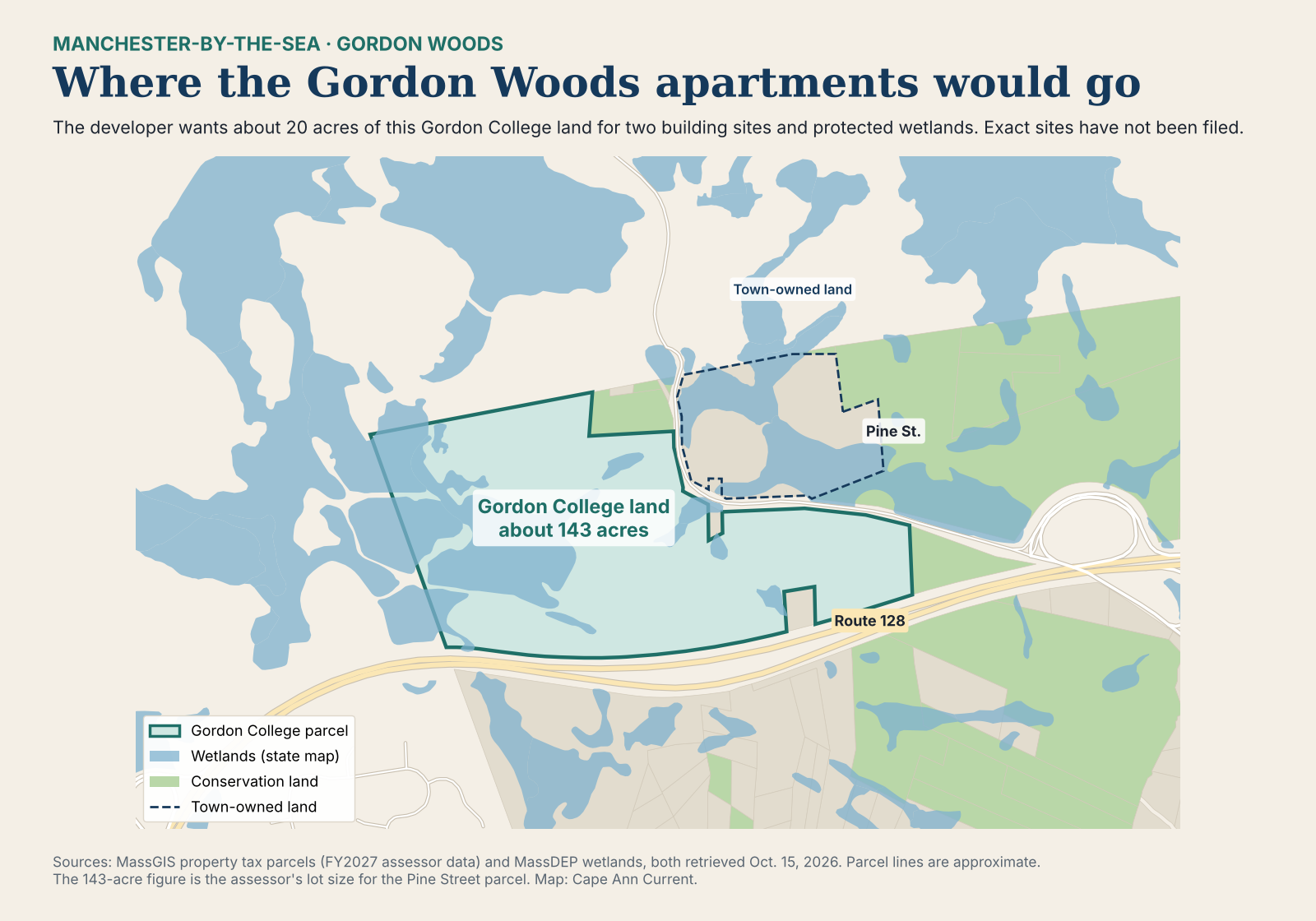
The state's property records list Gordon College's Pine Street land as one parcel of about 143 acres, more than the "about 90 acres" the developer estimated at the meeting. The land is in the town's limited commercial district, which is meant mostly for businesses and offices. Much of it is wetland.
- 245 apartments, down from 300 at first and 285 in May. The company said it made the cuts after people raised concerns about size.
- About 20 acres of Gordon Woods. That is two building sites of about 7.35 and 6.5 acres, plus about 6 acres of wetlands that would be protected forever under a conservation restriction. Gordon College would keep the rest, about 70 acres.
- Buildings four stories tall in front and five in back, about 50 to 60 feet, set into the hill.
- A quarter of the apartments, about 61 or 62, priced for households earning 80% or less of the area's median income. The rest would rent at market prices. JAG said those would run from about $2,800 a month for a one bedroom to about $5,000 for a three bedroom, around $3,500 on average.
- About half one bedroom apartments, with more two and three bedroom units than in earlier versions.
JAG said its next step is asking the Select Board for a letter of support. That opens a state review, and then a hearing before the Zoning Board of Appeals. The company has not filed yet.
Who decides, and when
Under the state's 40B law, a developer that sets aside enough affordable homes can ask one town board for a single permit instead of following every local zoning rule.
- Select BoardJAG asks for a letter of support for the state's local initiative program.
- State reviewThe state decides if the project is eligible.
- Zoning Board of AppealsPublic hearings on the permit, where residents can speak.
- Planning BoardMust approve splitting the Gordon land into new lots.
Steps as described by JAG and Planning Board members at the Oct. 13 meeting. JAG has not filed yet.
What board members said
Creighton said she thinks JAG has done a good job of meeting with groups around town. But she said many residents do not know about the plan yet. Many people walk, ski and walk their dogs in Gordon Woods and think of it as public land, she said, though it is private land owned by the college.
She said the plan should shrink far more, to about 60 apartments. She warned that "when the public wakes up on this," the reaction will "no longer be polite."
"I think that the scale question is not 300 to 245. It's 300 to go to 60."
Planning Board Chair Sarah Creighton, Oct. 13She said the rents are too high to meet the town's housing plan, which calls for homes that people like town workers can afford. She also said state MassWorks grants "should be for town projects, not for a private developer," as the town plans a new elementary school and downtown work. She said the idea of a MassWorks grant for the project had come up at a Select Board meeting.
Member Sandy Bodmer-Turner said the roughly 14 acres of building land equals about 100 lots the size of those in the oldest parts of town, where two family homes are allowed. She asked JAG to think about a very different layout. Another member suggested JAG look at the town's new senior housing rules, which would allow about 60 units on six acres with a special permit.
Members also asked about keeping the trails open during construction, the smell from the compost site and what happens if the apartments do not rent. JAG said it would study the trails with a builder, plant a thicker buffer of trees on its side of the street and offer deals such as a free month if it needs to fill units. It said a market study found strong demand on the North Shore. JAG said it would not open a cafe or other business that could compete with downtown.
Board members said they appreciated JAG coming in. No one from the public spoke.
New sign rules head to town meeting
The board voted to send its rewrite of the town's sign rules to the Select Board for the fall town meeting. The changes include a ban on flashing, lighted and electronic screen signs that can be seen from the street, a ban on signs projected onto the ground, and a size limit of 9 square feet for business flags. The board plans a public hearing at its first meeting in November.
Next up: the rest of the business district
The board also voted to study the rest of Manchester's general business district. That is the zone for shops, offices and mixed uses. It is shown in red on this map.
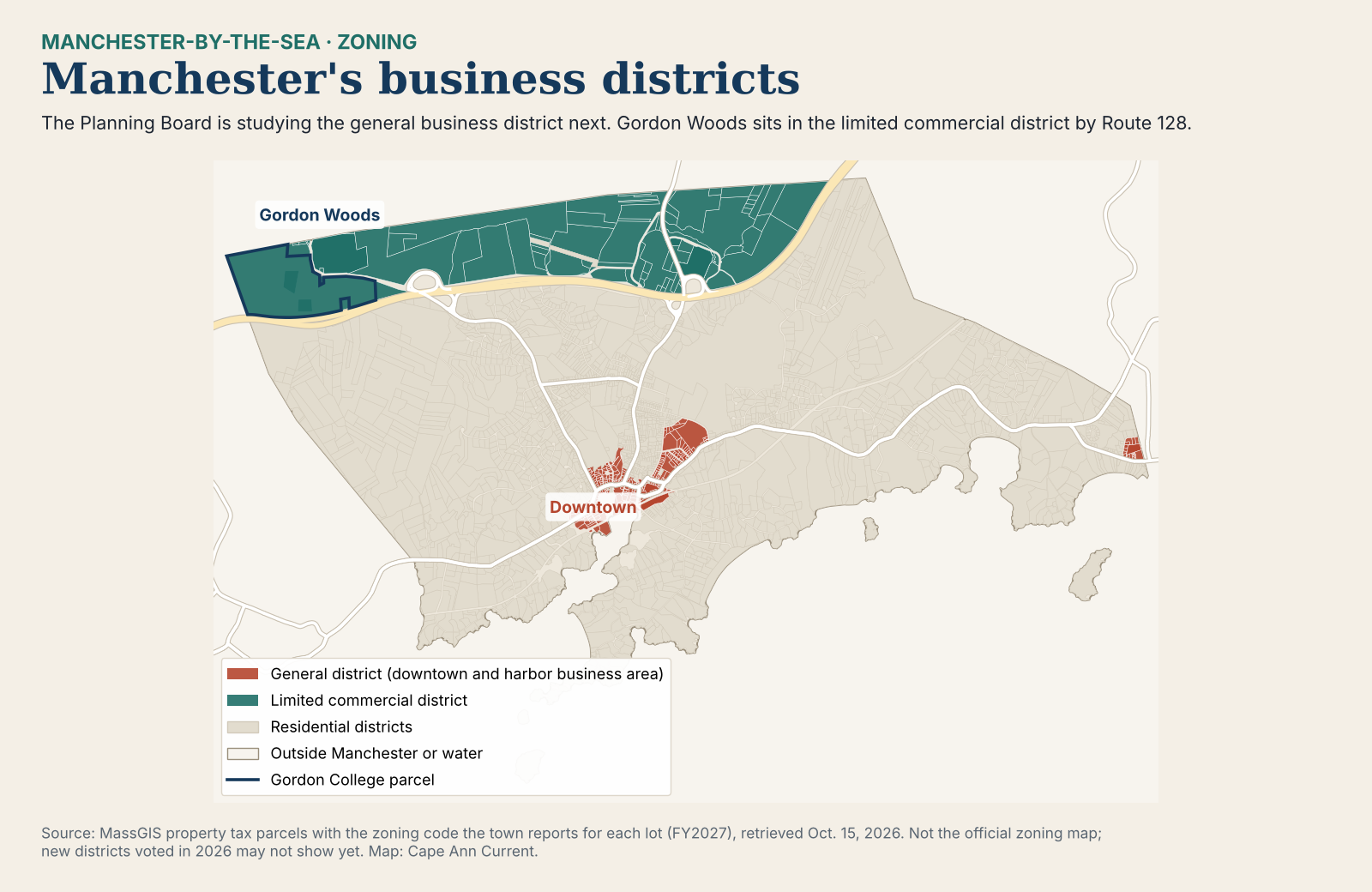
What the district is. Zoning splits a town into zones. Each zone has rules for what can be built there and how big. The general district covers the downtown shops, but it is much bigger than that. It runs from the boatyards up Summer Street, and it includes a small block on the Gloucester line where the Surf restaurant used to be. Some homes sit inside it too.
Downtown came first. The town already studied the downtown part and passed new zoning for it last spring. Downtown is only about one fifth of the district. Board members walked the rest of it on three nights to get ready for this next step.
What the study will do. A planning consultant will hold a public workshop where residents can say what they want these areas to look like. She will also meet with the Historic District Commission and other town boards. At the end, she will give the town a work plan: a list of zoning changes to make. Marc Resnick, the town's director of land management, said most changes will likely move the lines between zones. Some could be new rules for areas along the water that flood.
Why not write the new rules now? One member asked the consultant to draft the actual zoning language, since that is the slow part. Resnick said it is too soon, because residents need to weigh in first.
Cost and timing. The consultant's bid was $25,000, and it was the only one that came in. The board approved it. A state grant pays for the study, along with town money the grant requires as a match. The work must be finished by the end of June 2027. Zoning changes can come after that.
Sidewalks and streets, too. The same grant pays for a separate project to redo downtown's sidewalks and streets. The town will hire a second firm to survey the area and help pick a surface, such as brick, pavers or concrete, and draw an early design. Both projects will run at about the same time.
How you can take part. Watch for the date of the public workshop. That is the best time to tell the town what you want for the business district. Planning Board meetings are open to the public, and you can also email the board through the town website.
Also at the meeting
- Data centers: A member asked to add data centers to the board's list of zoning topics, to make clear they are not allowed in town.
- Question 7: Several members said they dislike Question 7 on the Nov. 3 state ballot, which would allow single family homes on 5,000 square foot lots in areas with town water and sewer. The board did not vote on it.
- The board approved its Sept. 14 and Sept. 28 minutes.
Earlier coverage: Manchester Select Board roundup, including JAG's Pine Street plan (Sept. 30) and Manchester meetings this week (Oct. 12).
How we did this: Cape Ann Current watched the meeting online and checked names against the agenda and the board's past minutes. This story was produced with the help of AI tools and checked against the documents listed below. If you see an error, tell us at [email protected].
Sources
Do you trust this story?
See something wrong? Email [email protected]. Read our standards and corrections policy.