
Two Accounts of One Wreck
Grades 9-12 · History and Social Science, English Language Arts, News and Media Literacy · Manchester-by-the-Sea, Rockport
When the records of a death at sea disagree, what can a careful researcher honestly say happened, and how should we name and remember the person who died?
Two 55-minute class periods
On Jan. 6, 1892, a federal ship called the Gallatin hit a hidden ledge off Manchester in a snowstorm. One man aboard died. Every account agrees on that much. But the accounts do not agree on who he was or exactly how he died. In this lesson you will work like a fact checker. You will read the records, line them up against each other and decide what can be verified and what cannot. Then you will test your method on a second Cape Ann wreck, the Liberty ship Charles S. Haight, which went aground off Rockport in 1946. At the end you will write a short note the way a careful newsroom would, and think about how a community should remember someone when the record is incomplete.
Primary source
R1. Source 1: Manchester's town history, 1895
Source: D. F. Lamson, History of the Town of Manchester, Essex County, Massachusetts, 1645-1895 (Town of Manchester, 1895), p. 358. Transcribed from a scan; spelling as printed. Link. Rights: Public domain (published 1895)
Primary source
R2. Source 2: The ship's muster roll, January 1892
| Name as printed | Rank or rate as printed |
|---|---|
| Eric Gabrielson | Captain. |
| H. E. Wooster | Pilot. |
| J. Jacobson | Carpenter. |
Source: Exhibit A, 'Muster roll of officers and crew attached to the revenue steamer Gallatin when wrecked, January 6, 1892,' printed in U.S. House of Representatives, Report No. 1830, 56th Congress, 1st Session, 'Sufferers by Wreck of United States Revenue Cutter Gallatin' (May 29, 1900), p. 2. Transcribed from a scan; spelling as printed. Link. Rights: Public domain (U.S. federal government work)
Primary source
R3. Source 3: A Treasury Department letter and a committee report, 1892
Source: Exhibit B, letter of O. L. Spaulding, Acting Secretary of the Treasury, to Sen. William P. Frye, Jan. 26, 1892; and the report of the House Committee on Claims, House Report No. 1479, 52nd Congress (1892); both printed in U.S. House of Representatives, Report No. 1830, 56th Congress (May 29, 1900), p. 2. Transcribed from a scan; spelling as printed. Link. Rights: Public domain (U.S. federal government work)
Primary source
R4. Sources 4A to 4D: Newspaper reports printed the next day, Jan. 7, 1892
Source: Chronicling America, Library of Congress. Each excerpt was transcribed from a scan of the printed page; spelling as printed. Full citations for each paper are listed under the excerpts. Link. Rights: Public domain (published 1892)
Primary source
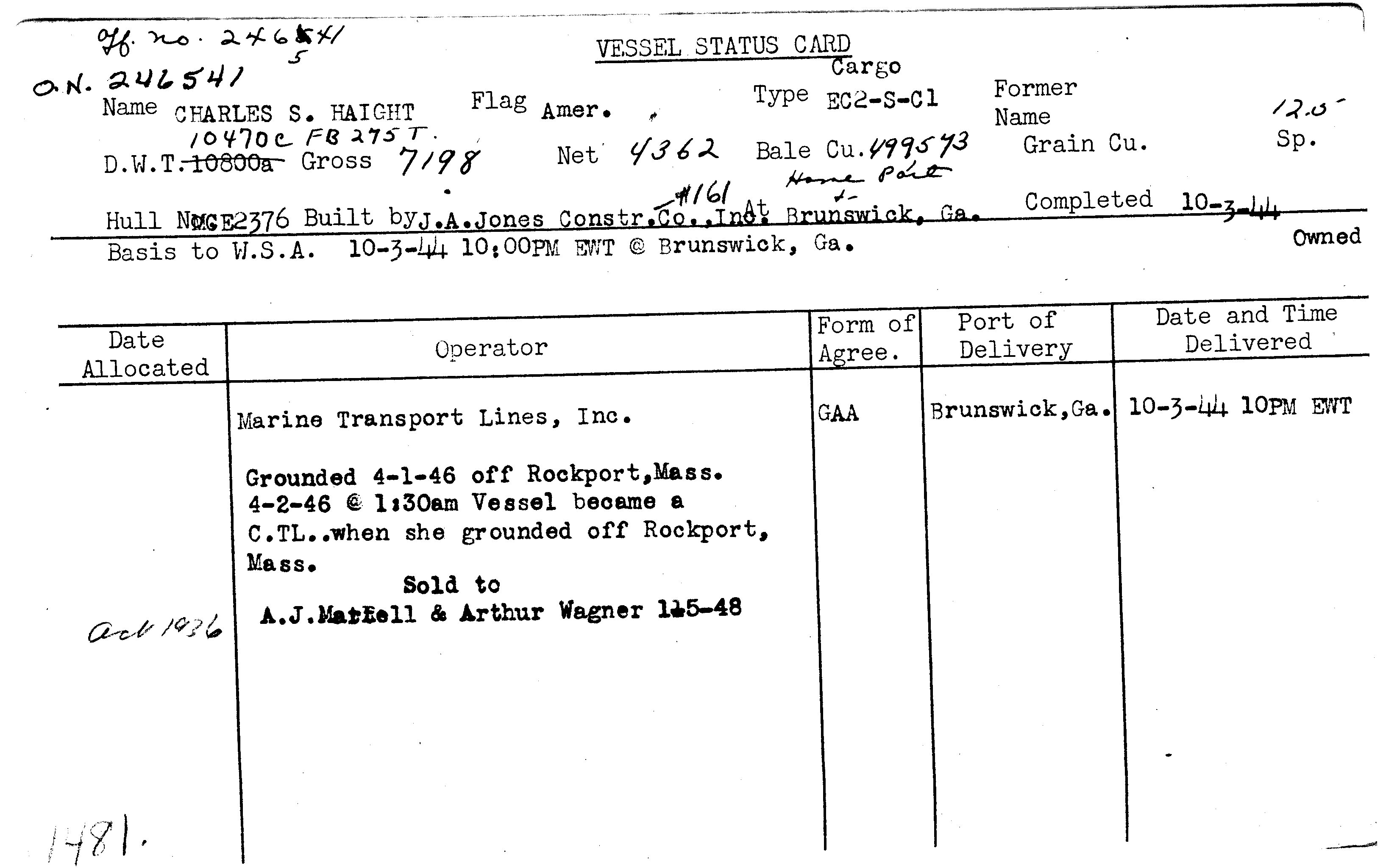
R5. Source 5: A federal vessel status card, 1946
Source: U.S. Maritime Administration, Vessel Status Card, Charles S. Haight (card 1AE_01), typed entries made after the grounding. Transcribed from a scan of the typed card; spelling and spacing as printed. Link. Rights: Public domain (U.S. federal government work)
Summary by Cape Ann Current
R6. Source 6: What other accounts of the Haight say (our summary)
Source: Summary written by Cape Ann Current from: U.S. Maritime Administration, Ship History Database, 'Charles S. Haight'; Massachusetts Board of Underwater Archaeological Resources, 'Charles S. Haight'; Town of Rockport, 'Charles S. Haight.' Link. Rights: Our summary of facts; the state and town pages are not quoted
A1. Source log
Fill in one row for each source: 1, 2, 3, 4A, 4B, 4C and 4D. Use short phrases. Quote exact words in the last two columns.
- Who created this source, and what was their job or role?
- When was it created? Count how many days or years after Jan. 6, 1892.
- Was the creator an eyewitness? If not, what can you tell about where the information came from?
- Why was this source made, and who was meant to read it?
- What exact words does it use to identify the man who died?
- What exact words does it use to describe how he died?
- Source check: Source 4A also appeared word for word in a Maine paper. Should those two printings count as one source or two? Explain.
- Source check: What does the dateline in Source 4D tell you about how carefully that report was checked?
A2. Corroboration matrix
For each claim, write S if the source supports it, C if the source contradicts it and N if the source does not mention it. Add a few quoted words when you can. Then rate the claim as verified, probable, contested or unknown and give a one-line reason. Note any sources that may not be independent of each other.
- Claim 1: One man aboard the Gallatin died in the wreck.
- Claim 2: His name was J. Jacobson.
- Claim 3: His first name was Jacob.
- Claim 4: He was the ship's carpenter.
- Claim 5: He was a seaman.
- Claim 6: He was Danish.
- Claim 7: The falling smokestack struck him.
- Claim 8: The blow from the smokestack killed him.
- Claim 9: He was knocked into the water and drowned.
- Claim 10: His body was never recovered.
- Which single record, if you could find it, would most change your ratings? Where might it be kept?
A3. The Haight date: one night, two dates
Work with a partner. Use Sources 5 and 6.
- What date does the typed card give for the grounding? What date and time does the state account give?
- Read the second line of the card carefully. Does the card agree with itself? Explain.
- The card and the online database come from the same federal agency. What does it tell you that they give different dates?
- The Town of Rockport page and the state page use nearly the same words. Do they count as one source or two? Why?
- List two possible reasons a record could be one day off for an event that happened near midnight. Label these as possibilities, not facts.
- Write one sentence about when the Haight went aground that a careful newspaper could print today without overstating what is known.
- Name one record that could settle the question, and say where you would look for it.
A4. What we know / What we don't
Write a note of 200 to 300 words about the death aboard the Gallatin, in the style of a newsroom note that is published alongside a story. Use two headings: What we know and What we don't know. Every fact must name its source in the sentence, for example 'according to the Treasury Department's Jan. 26, 1892, letter.' Use your matrix ratings. Do not use the word 'definitely' unless two independent records agree.
- Open with one sentence that states what all the records agree on.
- Under What we know, give at least three facts, each with its source.
- Under What we don't know, give at least two open questions and explain why the records cannot answer them yet.
- Name the man who died the way you think is most accurate, and explain your choice in one sentence.
- End with one record or archive that could answer an open question.
A5. Remembering with care
Discuss these questions in your group, then write the exit ticket on your own.
- The town history calls the man who died 'one seaman, a Dane' and does not give his name. The federal records give a name and a job. Which matters more for remembering a person, and why?
- Some newspapers say Jacob Jacobson; the muster roll says J. Jacobson. If you were carving a name on a memorial, which would you use, and how would you note the other?
- Is it fair to write that he 'drowned' or that he was 'killed instantly'? What does each choice claim to know?
- Nothing we found ties J. Jacobson to Cape Ann except the place he died. Should Manchester remember him? How?
- The Haight's crew all survived, according to every account we have. Why is it important not to add drama or danger to a story that the records do not support?
- Exit ticket: Write one line, under 25 words, that a memorial or anniversary story could carry for the man who died aboard the Gallatin. It must be accurate to the records.
Talk about it
- Lamson wrote three years after the wreck, for his own town. The newspapers wrote the next day, for readers far away. How might time and audience change what each one chose to include?
- Several Jan. 7 reports say Jacobson was killed 'instantly,' but one says 'It is believed.' What is the difference between those two ways of writing, and which is more honest?
- Two newspapers that print the same wire report agree word for word. Why does that agreement prove less than it seems to?
- The Treasury letter is an official record. Does official mean correct? What would you want to know about how the Treasury learned what it reported?
- In the Haight case, the same agency gave two dates. What does that suggest about trusting a record just because it came from the government?
- If a reader asked you to 'just say what happened,' how would you answer without hiding what is uncertain?
Show what you learned
Write a 200- to 300-word 'What we know / What we don't' note about the man who died when the revenue cutter Gallatin wrecked off Manchester on Jan. 6, 1892. Attribute every fact to a named source, rate your certainty honestly and name him accurately and respectfully. Your note will be scored on use of evidence, corroboration, handling of uncertainty and respectful remembrance.
Points: 20
Student files
Free from Cape Ann Current. No account needed. Source: Cape Ann Current. Teachers: lesson plan and answers.