
Two Accounts of One Wreck: teacher guide
Downloads
For students
Google Docs, Slides and Sheets copy links are coming. Until then, upload the Word, PowerPoint or Excel file to Google Drive and open it with Google Docs, Slides or Sheets.
For you only
Google Docs, Slides and Sheets copy links are coming. Until then, upload the Word, PowerPoint or Excel file to Google Drive and open it with Google Docs, Slides or Sheets.
- Grade band
- Grades 9-12
- Subjects
- History and Social Science, English Language Arts, News and Media Literacy
- Towns
- Manchester-by-the-Sea, Rockport
- Duration
- Two 55-minute class periods (sequence totals 110 minutes)
- Prerequisites
- Students can tell a primary source from a secondary source in general terms.; Students have read at least one news article closely and can find who, what, when and where.; No prior knowledge of the Gallatin or the Charles S. Haight is needed.
- Essential question
- When the records of a death at sea disagree, what can a careful researcher honestly say happened, and how should we name and remember the person who died?
- Version
- 1.0, 2026-10-05
- Review status
- Draft: awaiting classroom teacher review
- Lesson ID
CAC-LES-009
Objectives
Students will be able to:
- identify the creator, date, purpose and distance from the event for each of seven short sources about the Jan. 6, 1892, wreck of the revenue cutter Gallatin.
- build a corroboration matrix that records whether each source supports, contradicts or does not mention each of 10 claims about who died and how.
- rate each claim as verified, probable, contested or unknown and justify the rating by naming at least two sources and noting whether those sources are independent of each other.
- explain a one-day date conflict between a federal record and a newspaper-based account of the 1946 grounding of the Charles S. Haight and write a sentence that reports the date without claiming more certainty than the records allow.
- write a 200- to 300-word 'What we know / What we don't' note that attributes every fact to a source and names the dead man respectfully and accurately.
Massachusetts curriculum frameworks
| Code | Standard (verbatim) and source | How this lesson addresses it |
|---|---|---|
| RCA-H.9-10.6 | Compare the point of view of two or more authors for how they treat the same or similar topics, including which details they include and emphasize in their respective accounts. English Language Arts and Literacy Curriculum Framework (2017), Grades 9-10. Official framework, page PDF p. 144 (printed p. 141). | Students compare how a town historian, a federal official and four newspapers treat the same death, including which details each includes or leaves out. |
| RCA-H.11-12.8 | Evaluate an author’s premises, claims, and evidence by corroborating or challenging them with other information. English Language Arts and Literacy Curriculum Framework (2017), Grades 11-12. Official framework, page PDF p. 149 (printed p. 146). | Students test each account's claims by corroborating or challenging them against the muster roll, the Treasury letter and other reports. |
| RCA-H.11-12.9 | Integrate information from diverse sources, both primary and secondary, into a coherent understanding of an idea or event, noting discrepancies among sources. English Language Arts and Literacy Curriculum Framework (2017), Grades 11-12. Official framework, page PDF p. 149 (printed p. 146). | Students integrate seven primary sources and one secondary summary into one account of the death, recording every discrepancy in a matrix. |
| Standards for History and Social Science Practice [PS], Practice 4 | Analyze the purpose and point of view of each source; distinguish opinion from fact. History and Social Science Curriculum Framework (2018), Pre-K to Grade 12. Official framework, page PDF p. 24. | Students analyze the purpose and point of view of each source and separate reported facts from hedged statements such as 'It is believed.' |
| Standards for History and Social Science Practice [PS], Practice 5 | Evaluate the credibility, accuracy, and relevance of each source. History and Social Science Curriculum Framework (2018), Pre-K to Grade 12. Official framework, page PDF p. 24. | Students judge the credibility and accuracy of each source by its distance from the event, its own sources and whether it repeats another report. |
| News/Media Literacy [NML], Topic 3 [T3], standard 2 | Explain the conventions investigative journalists use and the steps they take in developing and checking the facts in news articles. History and Social Science Curriculum Framework (2018), High school. Official framework, page PDF p. 178. | Students practice the steps a journalist takes to check facts before publishing, then write a short note in a newsroom's 'what we know, what we don't' format. |
| News/Media Literacy [NML], Topic 4 [T4], standard 3 | Analyze how assertion differs from verification, evidence differs from inference. History and Social Science Curriculum Framework (2018), High school. Official framework, page PDF p. 178. | Students separate what each account asserts from what other records verify, and separate evidence from inference in their own writing. |
| RCA-H.11-12.6 | Evaluate authors’ differing points of view on the same historical event or issue by assessing the authors’ claims, reasoning, and evidence. English Language Arts and Literacy Curriculum Framework (2017), Grades 11-12. Official framework, page PDF p. 149 (printed p. 146). | Students weigh the differing points of view of the 1895 town history and the 1892 records by assessing each author's claims, reasoning and evidence. |
| Standards for History and Social Science Practice [PS], Practice 7 | Determine next steps and take informed action, as appropriate. History and Social Science Curriculum Framework (2018), Pre-K to Grade 12. Official framework, page PDF p. 25. | Students decide, as a class, how a memorial or news story should name J. Jacobson, and draft wording that a community could use. |
No Massachusetts standard addresses public memorials directly. The remembrance discussion connects only indirectly to RCA-H.11-12.6 and Practice 7. The News/Media Literacy standards are high school standards in the 2018 History and Social Science Framework.
Standards checked against the official Massachusetts DESE framework documents on Oct. 5, 2026.
Materials
- Student handout (one per student), which contains all readings, the source log, the corroboration matrix and the writing frame
- Slides for projection
- Pencils or pens in two styles, or a highlighter, for marking the matrix (marks are letters, so color is optional)
- Optional: devices with internet access to open the Library of Congress newspaper pages and the House report scan
Setup
Print one student handout per student. Read the teacher background below and the two Cape Ann Current stories linked at the end of this plan. Decide on groups of three or four for Day 1. If you have devices, open the House report on govinfo.gov and one Library of Congress newspaper page so you can show students what an original page looks like; the lesson works fully without them. Write the four rating words on the board: verified, probable, contested, unknown.
Teaching sequence
- 8 minutes Day 1: Warm up, one death in two sentences
Teacher: Project slide 2, which shows two short statements about the same death (one from the 1892 Treasury letter, one from the 1895 town history). Ask students to write for 3 minutes: What is the same? What is different? Which would you trust more, and why? Take three or four answers without confirming any.
Students: Write a quick response, then share one difference they noticed. - 7 minutes Day 1: Mini lesson, how corroboration works
Teacher: Use slide 3 to explain four checks a journalist or historian uses: Who made this, and when? How close were they to the event? What were their own sources? Is this source independent, or is it repeating another one? Explain that two newspapers printing the same wire story count as one source, not two. Introduce the rating words verified, probable, contested and unknown.
Students: Copy the four checks and four rating words into the margin of the source log. - 25 minutes Day 1: Source stations
Teacher: Groups read Readings R1 through R4 (seven sources in all). Each group member takes lead on one or two sources but everyone fills in the full source log (Activity A1). Circulate and push students to use the glossary in R4. Point out the dateline problem in Source D if no group notices it by minute 18.
Students: Read each source, complete one row of the source log for it and underline the exact words each source uses about the death. - 15 minutes Day 1: Begin the corroboration matrix
Teacher: Model the first claim row on the board as a class. Then groups complete as many rows of Activity A2 as they can. Collect handouts or have students keep them for Day 2.
Students: Mark each cell S (supports), C (contradicts) or N (not mentioned), quoting a few words where they can. - 10 minutes Day 2: Finish and rate the claims
Teacher: Groups finish the matrix and assign a rating to each claim with a one-line reason. Ask two groups to report how they rated the claims about cause of death and why. Do not settle the question; ask what evidence would.
Students: Finish the matrix, rate each claim and name the record that could change their rating. - 15 minutes Day 2: Second case, the Charles S. Haight date
Teacher: Introduce the 1946 Rockport grounding with slide 7. Students read R5 and R6 and answer Activity A3 in pairs. Emphasize that this case involves no reported deaths; it is a pure records problem.
Students: Compare the federal card, the federal database and the newspaper-based state account, then write one sentence that a careful newspaper could print. - 18 minutes Day 2: Write the note
Teacher: Explain the assessment (Activity A4) with slide 9. Remind students that every fact needs a source and that uncertainty must be stated plainly, not hidden. Students write individually.
Students: Write a 200- to 300-word 'What we know / What we don't' note about the death of J. Jacobson. - 12 minutes Day 2: Ethics of remembrance and exit ticket
Teacher: Lead the discussion in Activity A5 using slide 10. Close with the exit ticket: one line a memorial could carry for J. Jacobson. Collect the notes and exit tickets.
Students: Discuss how to name the dead respectfully and accurately, then write the exit ticket line.
Background for the teacher
The wreck. The Gallatin was a U.S. revenue cutter, a ship of the Treasury Department's Revenue Cutter Service, a forerunner of today's Coast Guard. Built of iron at Buffalo, N.Y., in 1871, she was assigned to Boston. On Jan. 6, 1892, she left Kittery, Maine (some reports say Portsmouth, N.H.), bound for Provincetown. In a heavy snowstorm with an easterly gale, the crew turned for Gloucester Harbor. The pilot took Great Egg Rock for Kettle Island and steered east; at about 11:15 a.m. by most accounts the ship struck Boo Hoo Ledge off Eagle Head, Manchester. As the boats were lowered, the smokestack fell and struck the carpenter. The rest of the crew rowed to the Manchester shore, sheltered at the house of J. F. Babcock and were sent to Boston by train that afternoon. The town history credits the town authorities with caring for them.
The conflict. The muster roll lists J. Jacobson as carpenter. The Treasury letter of Jan. 26, 1892, says "The carpenter was killed by the falling of the smokestack." Newspapers of Jan. 7, 1892, say he was killed instantly and that his body went overboard. Lamson's 1895 town history calls the dead man "one seaman, a Dane" who was "knocked into the water and drowned." Lamson is the only source we found that calls him a Dane, and he does not name his sources. The first name Jacob appears in the Pawtucket Tribune and the Waterbury Evening Democrat only. No source we found records an inquest, a recovered body or a burial. More could be in the Revenue Cutter Service muster rolls and the Gallatin's logbook held at the National Archives (Record Group 26), the Treasury inquiry record and Boston, Gloucester and Manchester papers of Jan. 7 to 9, 1892. J. Jacobson does not appear on Lamson's list of Manchester people lost at sea, and nothing we found ties him to Cape Ann except the place he died.
Independence of sources. The New Haven report (4A) appeared word for word in the Daily Kennebec Journal of Augusta, Maine, so the two printings are one wire source. The Pawtucket and Waterbury reports (4B and 4C) use different wording, but both may draw on Boston reports; their shared use of "Jacob" may come from one origin. The New-York Tribune (4D) misprints Manchester-by-the-Sea as being in "N. H." and gives the time as about noon; other reports say 11:15 a.m. (New Haven) or 11:10 (Pawtucket). The Pawtucket report also says "The other thirty-six men took to the boats," another figure that does not match the Treasury's. The crew count differs in the official records too: 7 officers, 1 pilot and 30 men and boys on the muster roll (38 names) versus 6 officers, the pilot and 29 men and boys in the Treasury letter. The muster roll may include two officers who were not aboard; one report said the ship sailed "two officers short."
Responsibility (optional extension). A wire report on Jan. 6 said "The fault seems to be with the pilot." A Boston Herald report reprinted in March 1892 said the inquiry placed responsibility on the captain. A House committee report in 1892 said the wreck "was not caused by any fault or negligence of officers or crew." These have not been reconciled in anything we found.
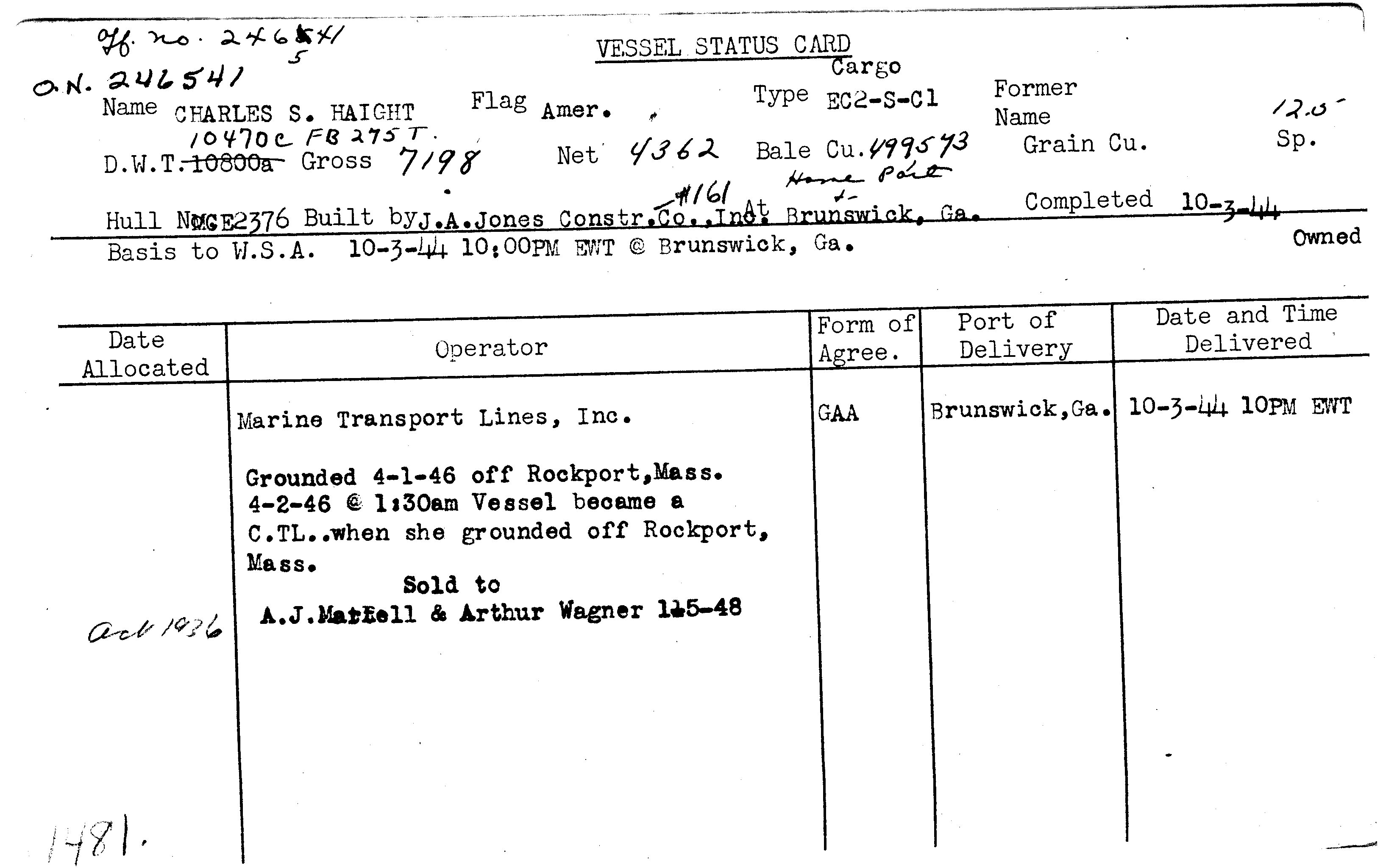
The Charles S. Haight. A Liberty ship completed in October 1944 at Brunswick, Ga., and operated for the government, the Haight was heading from Newport, England, to New York with empty holds when she went aground on Flat Ground about 1.5 miles east of Rockport. The typed federal status card says "Grounded 4-1-46," yet the next line of the same card dates the constructive total loss to 1:30 a.m. April 2, 1946, "when she grounded." The same agency's online database says April 2, 1946. The state underwater archaeology board, drawing on Boston and New York newspapers, says 12:07 a.m. April 2, and the Town of Rockport page repeats that account, so the state and town pages count as one source family. No source we reviewed reports any deaths or injuries. A Coast Guard report dated April 12, 1946, records that a court injunction was issued locally on the complaint of Rockport citizens to stop a salvage company from sinking the oil-laden stern. The date question could be settled by the Boston Globe of April 2, 1946, the Gloucester Daily Times of April 2 and 3, 1946 (Sawyer Free Library microfilm), or a Coast Guard casualty report at the National Archives. The cause of the one-day difference is not known; do not present any explanation as fact.
A note on the excerpts. All excerpts were checked against scans of the original pages. Quoted passages keep the original punctuation, including commas the Cape Ann Current house style would not use.
Handling sensitive topics
This lesson centers on a real man's death. Keep the focus on evidence and remembrance, not on injury. One newspaper excerpt (4B) mentions a head injury; it is kept because its hedge word "apparently" is evidence students need, but do not linger on it. Some students may have family members who work or worked at sea, or who died at sea; give a heads-up at the start of Day 1 and let students step out or take a different source if needed. Model respectful language: say "the man who died" or "J. Jacobson," never "the body" as a way of naming him. In the Haight case, remind students that no deaths are reported and that adding imagined danger would be inaccurate. If a student asks about Jacobson's family or background, say honestly that we have not found that information and point to the archives that might hold it.
Discussion prompts
- Lamson wrote three years after the wreck, for his own town. The newspapers wrote the next day, for readers far away. How might time and audience change what each one chose to include?
- Several Jan. 7 reports say Jacobson was killed 'instantly,' but one says 'It is believed.' What is the difference between those two ways of writing, and which is more honest?
- Two newspapers that print the same wire report agree word for word. Why does that agreement prove less than it seems to?
- The Treasury letter is an official record. Does official mean correct? What would you want to know about how the Treasury learned what it reported?
- In the Haight case, the same agency gave two dates. What does that suggest about trusting a record just because it came from the government?
- If a reader asked you to 'just say what happened,' how would you answer without hiding what is uncertain?
Formative checks
- After the mini lesson: thumbs up or down. Two newspapers print the same wire story. Is that two sources? Ask two students to explain.
- During source stations: check that each group has quoted exact words, not paraphrases, in the last two columns of the source log.
- After the matrix: each group posts its rating for Claim 8 and Claim 9 on the board; look for ratings that match the evidence cited.
- During the Haight case: read three of the pairs' printable sentences aloud and ask the class whether each one claims too much, too little or the right amount.
- Exit ticket line: check for accuracy (no unverified nationality or cause of death stated as fact) and respectful tone.
Assessment
Write a 200- to 300-word 'What we know / What we don't' note about the man who died when the revenue cutter Gallatin wrecked off Manchester on Jan. 6, 1892. Attribute every fact to a named source, rate your certainty honestly and name him accurately and respectfully. Your note will be scored on use of evidence, corroboration, handling of uncertainty and respectful remembrance.
Points: 20
Answer guidance
A1
- Source 1 (Lamson): a minister and local historian writing the official town history; 1895, about three years after; not an eyewitness and names no sources; written for Manchester readers as a permanent record. Words: 'One seaman, a Dane'; 'struck by the falling smoke-stack, knocked into the water and drowned.'
- Source 2 (muster roll): the ship's official crew list, made by the Revenue Cutter Service and printed by Congress as evidence for a claims bill; dated to the day of the wreck; an administrative record, not a narrative. Words: 'J. Jacobson' 'Carpenter.' It says nothing about how he died.
- Source 3 (Treasury letter and committee): the acting secretary of the Treasury, the ship's owner, writing 20 days later to a Senate committee about repaying the crew. Not an eyewitness; most likely relies on the captain's report (the committee report says its facts come from 'the statement of Captain Gabrielson'). Words: 'The carpenter was killed by the falling of the smokestack.' It gives a role but no name.
- Source 4A: a wire report datelined Manchester, printed the next day in New Haven and, word for word, in Augusta, Maine. Words: 'instantly killed J. Jacobson, the carpenter'; 'carried the body overboard.'
- Source 4B: Pawtucket Tribune, next day. Words: 'Jacob Jacobson'; 'breaking his neck apparently, and killing him instantly'; 'His body fell overboard and was lost.' Strong students notice 'apparently' and the different crew count ('thirty-six').
- Source 4C: Waterbury Evening Democrat, next day. Words: 'Jacob Jacobson, the ill-fated carpenter'; 'It is believed that Jacobson was instantly killed.' This is the only report that openly hedges.
- Source 4D: New-York Tribune special report, next day. Words: 'J. Jacobson, a carpenter.' It says nothing about how he died. The 'N. H.' dateline is wrong, which suggests the report was written or edited quickly and far from the scene.
- Source check answers: the Augusta and New Haven printings are one source, because agreement between copies of one report adds no new evidence. The dateline error in 4D is a reason to be careful with its other details, such as the time 'about noon.'
A2
- Claim 1, one man died: S in Sources 1, 3, 4A, 4B, 4C and 4D; N in Source 2. Rating: verified.
- Claim 2, named J. Jacobson: S in 2, 4A and 4D, and also in 4B and 4C ('Jacob Jacobson'); N in 1 and 3. Rating: verified (official muster roll plus independent newspaper reports).
- Claim 3, first name Jacob: S in 4B and 4C only; Source 2 gives only the initial J., which does not contradict it. Rating: probable at most, or unknown; two papers that may share one origin.
- Claim 4, carpenter: S in 2, 3, 4A, 4B, 4C and 4D; C in 1 ('seaman'). Rating: verified.
- Claim 5, seaman: S in 1 only; C in 2 and 3. Rating: contested, and the weight of evidence is against it. Students may suggest Lamson used 'seaman' loosely to mean a sailor; accept this only if labeled as a possibility.
- Claim 6, Danish: S in 1 only; N everywhere else. Rating: unknown (single later source with no stated evidence). Watch for students who infer nationality from his name or from other names on the muster roll; that is inference, not evidence.
- Claim 7, struck by the smokestack: S in 1, 3, 4A, 4B and 4C; N in 2 and 4D. Rating: verified.
- Claim 8, killed by the blow: S in 3 (by implication, 'killed by the falling of the smokestack'), 4A and 4B ('apparently' attaches to the injury); hedged S in 4C ('It is believed'); C in 1; N in 2 and 4D. Rating: probable. The earliest and official sources favor it, but no eyewitness is quoted, no body was examined and no inquest record has been found.
- Claim 9, drowned: S in 1 only; C in 3, 4A, 4B and 4C. Rating: contested; it rests on one later source that names no evidence. Either way, all sources agree he went into the sea.
- Claim 10, body never recovered: 4B says 'His body fell overboard and was lost'; 4A says the stack 'carried the body overboard'; the others are N. Rating: unknown. The reports were written within a day; no later record of recovery or burial has been found, but that does not prove there was none.
- Most useful record: the Gallatin's logbook or the Revenue Cutter Service muster rolls at the National Archives (Record Group 26), a Treasury inquiry record, or a Massachusetts death record. Accept any reasoned answer that names a specific record type and a holder.
A3
- The card says 'Grounded 4-1-46' (April 1, 1946). The state account says 12:07 a.m. on April 2, 1946.
- The card does not fully agree with itself: its next line dates the constructive total loss to 1:30 a.m. April 2, 1946, 'when she grounded.' Strong answers notice this.
- Same agency, different dates: being official does not make every entry consistent; records are made by different people at different times for different purposes.
- Rockport and the state: one source family. The town page repeats the state account, so their agreement is not independent confirmation.
- Possible reasons (must be labeled as possibilities): the event happened minutes after midnight and someone dated it by the evening it began; a clerk recorded the date of a report rather than the event; a typing error; a different time standard. The records do not tell us which, if any, is true.
- Model sentence: 'The Charles S. Haight went aground on Flat Ground off Rockport overnight April 1 to 2, 1946; a state account based on newspapers of the time puts it at 12:07 a.m. April 2, while a federal status card gives April 1.' Accept any version that attributes both dates or uses the overnight framing.
- Records that could settle it: the Boston Globe of April 2, 1946; the Gloucester Daily Times of April 2 and 3, 1946, at the Sawyer Free Library; a Coast Guard casualty report at the National Archives; the ship's logbook.
A4
- A strong note opens with what every account agrees on: one man died when the falling smokestack struck him as the boats were being lowered, and he went into the sea.
- What we know should include, with attribution: the carpenter J. Jacobson is on the official muster roll; the Treasury's Jan. 26, 1892, letter says the carpenter was killed by the falling smokestack; next-day newspapers say the same and say his body went overboard; the rest of the crew reached Manchester.
- What we don't know should include: whether he died from the blow or drowned (the 1895 town history says drowned); his full first name; his nationality; whether his body was recovered or buried.
- Naming: the most defensible choice is 'J. Jacobson, carpenter of the revenue cutter Gallatin,' with a note that some 1892 newspapers gave his first name as Jacob.
- Deduct under the rubric for any statement, made as fact, that he was Danish or a seaman or that he drowned; and for invented details such as age, family or hometown.
A5
- There is no single right answer to the discussion questions. Look for reasoning that ties naming choices to evidence and that treats Jacobson as a person, not a plot point.
- Exit ticket example: 'J. Jacobson, carpenter, revenue cutter Gallatin, lost off Eagle Head, Manchester, Jan. 6, 1892.' Accept lines that include his recorded name and role and avoid unverified details.
- On the Haight: the honest story is a grounding, a careful evacuation and a civic fight over oil, not a tragedy. Students should see that restraint is part of accuracy.
Rubric
| Criterion | 4 | 3 | 2 | 1 |
|---|---|---|---|---|
| Use of evidence and attribution (5 points) | Every fact is attributed to a specific, named source; quotations are exact; at least four sources are used. (5 points) | Nearly all facts are attributed; at least three sources are used; one attribution is vague. (4 points) | Some facts are attributed, but several are not, or only two sources are used. (3 points) | Few or no attributions; facts appear without sources. (1 to 2 points) |
| Corroboration and source judgment (5 points) | Explains which claims rest on independent sources and which rest on one source or repeated wire copy; weighs the 1895 history against the 1892 records with reasons. (5 points) | Distinguishes stronger from weaker claims with mostly sound reasons; mentions independence at least once. (4 points) | Notes that sources disagree but does not explain why one is stronger. (3 points) | Treats all sources as equally reliable or picks one without reasons. (1 to 2 points) |
| Precision about certainty (5 points) | Certainty language matches the evidence throughout (for example 'according to,' 'one source says,' 'no record found'); open questions are stated plainly and paired with a record that could answer them. (5 points) | Certainty language is mostly accurate; one claim is slightly overstated or understated. (4 points) | Several claims are overstated, such as stating the cause of death as settled. (3 points) | Contested or unverified claims are presented as fact. (1 to 2 points) |
| Respectful and accurate remembrance (5 points) | Names J. Jacobson accurately with his role, notes the name variant, avoids unverified traits and sensational detail and clearly separates the victim from survivors, officers, the owner and the people who helped. (5 points) | Names him accurately and respectfully; one minor lapse in tone or one roles mix-up. (4 points) | Name or role is inaccurate, or the tone is casual or dramatic in places. (3 points) | Does not name him, uses an unverified trait as fact, or sensationalizes the death. (1 to 2 points) |
Differentiation
Multilingual learners
- Preview the glossary in R4 and the four rating words with simple sketches or gestures described aloud, and add home-language equivalents.
- Allow students to fill in the source log with short phrases and quote only the key words, such as 'killed' or 'drowned.'
- Provide sentence frames for the note: 'According to ___, ___.' 'We do not know ___ because ___.' 'One source says ___, but ___ says ___.'
- Pair students so that one reads aloud and the other marks the matrix, then switch.
Students with disabilities
- Offer a reduced matrix with Claims 1, 2, 4, 6, 8 and 9 only.
- Read the sources aloud or provide them in a screen-reader-friendly digital copy; the handout uses no images, and matrix marks are letters, not colors.
- Allow the note to be dictated, typed with speech-to-text or written as bullet points under the two headings.
- Give extended time for the writing task, or let students finish the note as homework.
Advanced learners
- Add the responsibility question: compare the wire report's 'The fault seems to be with the pilot' with the 1892 committee's finding of no fault and decide what can be said.
- Have students open the full House report on govinfo.gov and count the names on the muster roll, then explain the difference between the muster roll and the Treasury letter's crew count.
- Ask students to draft a records request: a short, polite email to the National Archives asking about the Gallatin's logbook for Jan. 6, 1892, without sending it.
Print, low-bandwidth and extension options
Print: Everything students need is in the student handout: readings, source log, matrix and writing frame. Print single-sided so groups can spread out sources. The slides can be printed as handouts if no projector is available.
Low bandwidth: No internet access is needed in class. All excerpts are printed in the handout. The original scans on govinfo.gov and loc.gov are optional and can be shown from a single teacher device or skipped.
Extensions:
- Visit or contact the Manchester-by-the-Sea Museum or the Manchester Historical Museum to ask whether any record of the Gallatin wreck or of J. Jacobson survives locally.
- Read the Gloucester Daily Times for April 2 and 3, 1946, on microfilm at the Sawyer Free Library and report what time and date it gives for the Haight grounding.
- Write a 150-word correction notice for a fictional news story that called Jacobson 'a Danish seaman who drowned,' using the newsroom style of a real correction.
- Compare this lesson's method with how today's newsrooms handle conflicting early reports after a disaster, using a published corrections policy as a guide.
Google Classroom: ready to paste
Assignment title: Two Accounts of One Wreck: What We Know / What We Don't
Student instructions:
Make your own copy of the student handout. Over two class periods you will read seven sources about the man who died when the revenue cutter Gallatin wrecked off Manchester on Jan. 6, 1892, complete the source log and the corroboration matrix and answer the questions about the Charles S. Haight. Then write a 200- to 300-word note with two headings, What we know and What we don't know. Every fact must name its source. Turn in your handout with the note and your exit ticket line. The slides are attached for reference.
Suggested points: 20
Attach:
- student-handout.docx: Make a copy for each student
- slides.pptx: Students can view file
Never attach the teacher guide to student work. See how to use this lesson in Google Classroom.
Citations and rights
- D. F. Lamson, History of the Town of Manchester, Essex County, Massachusetts, 1645-1895 (1895), p. 358, Internet Archive. https://archive.org/details/historyoftownofm00lams. Public domain (published 1895)
- U.S. House of Representatives, Report No. 1830, 56th Congress, 'Sufferers by Wreck of United States Revenue Cutter Gallatin' (May 29, 1900), reprinting the muster roll (Exhibit A) and the Treasury letter of Jan. 26, 1892 (Exhibit B), govinfo. https://www.govinfo.gov/app/details/SERIALSET-04027_00_00-075-1830-0000. Public domain (U.S. federal government work)
- Morning Journal and Courier (New Haven, Conn.), Jan. 7, 1892, p. 3, Chronicling America, Library of Congress. https://www.loc.gov/resource/sn82015483/1892-01-07/ed-1/?sp=3. Public domain (published 1892)
- Pawtucket Tribune (Pawtucket, R.I.), Jan. 7, 1892, p. 1, Chronicling America, Library of Congress. https://www.loc.gov/resource/sn92064071/1892-01-07/ed-1/?sp=1. Public domain (published 1892)
- Waterbury Evening Democrat (Waterbury, Conn.), Jan. 7, 1892, p. 1, Chronicling America, Library of Congress. https://www.loc.gov/resource/sn94053256/1892-01-07/ed-1/?sp=1. Public domain (published 1892)
- New-York Tribune, Jan. 7, 1892, p. 1, Chronicling America, Library of Congress. https://www.loc.gov/resource/sn83030214/1892-01-07/ed-1/?sp=1. Public domain (published 1892)
- U.S. Maritime Administration, Vessel Status Card, Charles S. Haight (card 1AE_01). https://vesselhistory.marad.dot.gov/cards/1AE_01.png. Public domain (U.S. federal government work)
- U.S. Maritime Administration, Ship History Database, Charles S. Haight. https://vesselhistory.marad.dot.gov/ShipHistory/Detail/5761. Public domain (U.S. federal government work)
- Massachusetts Board of Underwater Archaeological Resources, 'Charles S. Haight'. https://www.mass.gov/info-details/charles-s-haight. Facts only, summarized in our words; page text not reproduced
- Town of Rockport, 'Charles S. Haight'. https://rockportma.gov/209/Charles-S-Haight. Facts only, summarized in our words; page text not reproduced
- U.S. Coast Guard bi-weekly report excerpt, April 12, 1946, U.S. Maritime Administration archive (teacher background). https://vesselhistory.marad.dot.gov/documents/CharlesSHaight_5761_001.pdf. Public domain (U.S. federal government work)
Lesson text by Cape Ann Current, free to use and adapt under our Free Access and Attribution Policy. Credit: "Source: Cape Ann Current." with a link to https://capeanncurrent.com/classroom/two-accounts-of-one-wreck/. Public domain excerpts remain public domain; other sources keep their own terms, listed above. Version 1.0, 2026-10-05. Draft: awaiting classroom teacher review.