
License plate readers and Cape Ann: the crime numbers, the unions, the money and the questions to ask
Automated license plate readers are spreading across the North Shore, but not on Cape Ann. Here is what local crime data, the research, police unions, Washington and the companies selling the cameras say about whether our towns should have them.

None of Cape Ann's four police departments is listed as a customer of the largest seller of automated license plate readers, and we found no current public record of any of them using one. All around them, the question of whether they should is being argued in city councils, union halls, Congress and venture capital boardrooms. Here is what the evidence says, as far as it goes, and what our towns would have to decide.
What the cameras do
Automated license plate readers, known as ALPRs, are cameras that photograph every passing car, read its plate and log the time and place. Police search the records to find stolen cars, missing people and suspects' vehicles, and get alerts when a plate on a watch list drives by. Some are mounted on poles, some on cruisers.
Several companies sell them. The largest is Flock Safety, which says it has more than 120,000 cameras in 49 states and sells them by subscription. Motorola Solutions owns the Vigilant plate reader network, and Axon, the maker of Tasers and body cameras, sells readers built into streetlights and cruisers. Massachusetts has more than 1,200 of the cameras, about 990 of them Flock's, according to a volunteer map cited by Axios, with 173 in Essex County.
Close to home
None of Cape Ann's four communities is listed as a Flock customer in a Boston.com survey of every Massachusetts city and town updated at the end of September, and volunteer camera maps show none reported in the four towns. Our search of town budgets, annual reports, grant lists and meeting minutes from 2023 through 2026 found no plate readers either. Essex's 2025 annual report, for example, lists the department's equipment in detail, from Tasers to body cameras, with no plate reader.
Gloucester has tried one before. In February 2011 the state's public safety office awarded the Gloucester Police Department $22,362 for a plate reader camera system to mount on a cruiser, according to state records the ACLU of Massachusetts obtained and published. The city's application said the cruiser would patrol downtown around the clock and the beach parking lots, and cited traffic on Route 128, Route 127 and Route 133. We could not find whether the reader was installed or is still in use; it does not appear in any later city record we found. Separately, a city official told the City Council in 2023 that cameras that read plates are used to enforce parking.
Several neighbors use plate readers now, and the last few months show what can happen.
Beverly has four plate readers, from Flock, and keeps them. A City Council committee meeting in April drew residents worried about who can see the data, and the mayor said he would meet with the company.
Salem ended its Flock contract in July. The mayor said the company's protections for the data were not good enough, and the city moved to plate readers it owns itself, which shows the choice is not always cameras or no cameras.
In Lynn, an audit in August turned up a pattern of searches that concerned the department, and two officers were placed on leave while it investigated.
Swampscott owns no plate readers, yet one of its officers was placed on paid leave in September over possible misuse of the Flock system. The department had been able to search cameras run by partner communities. That case shows how one town's cameras can be searched by officers in the next town over.
Methuen ended its Flock contract on Sept. 23 after an audit concluded the data was not protected well enough, a decision that followed a city councilor learning her own plate had been searched by a neighboring department.
Haverhill, with 19 cameras, voted in August to have its city solicitor draft an ordinance setting rules for them. The same Boston.com survey lists Peabody, Saugus and North Andover as active Flock customers.
What crime looks like on Cape Ann
The cameras are sold mainly as a way to catch car thieves and burglars, so we pulled four years of FBI data for all four departments.
Those crimes are rare here. In 2025 the four communities together reported 14 motor vehicle thefts and 26 burglaries, among about 47,000 residents. That works out to about a third of the statewide rate for car theft and about half the state rate for burglary.
Gloucester accounts for most of it. From 2022 through 2025 the city reported 51 vehicle thefts and 104 burglaries, and cleared, usually meaning an arrest, 24 percent of the thefts and 37 percent of the burglaries. Statewide, police cleared 11 percent of vehicle thefts and 21 percent of burglaries in 2025. Rockport, Essex and Manchester each reported no more than four burglaries or two vehicle thefts in any year.
Violent crime follows the same pattern. Gloucester reported 69 violent crimes in 2025, a rate about a quarter below the state's, and cleared 74 percent of them, against 55 percent statewide. Rockport reported three.
Explore Cape Ann's crime numbers
Pick a crime, switch between rates and counts, and compare Cape Ann with nearby cities. Tap a point for details.
Do the cameras work?
The research is mixed and mostly older than today's systems. A U.S. Justice Department evidence review rates license plate readers "ineffective" as a crime deterrent, based on randomized experiments that found no drop in crime where they were used. Studies funded by the department's research arm found the readers helped recover more stolen cars, but clearance gains in one large city were not statistically significant once other factors were accounted for.
The newest study points the other way. Two University of South Carolina researchers studied 216 agencies that installed Flock's fixed cameras and found vehicle thefts fell about 11 percent afterward. Arrests for vehicle theft rose about 16 percent, but the authors note that rise began a few months before the cameras went up, which weakens the case that the cameras caused it, and they found no overall improvement in how quickly stolen cars were recovered. The study has not been peer reviewed. Flock supplied information on when its cameras were installed and says it did not fund the study or shape it. Flock, the largest seller, says its cameras help solve about one in 10 reported crimes in the country, a figure based on a company survey that shows a correlation, not cause.
What about officer safety?
Supporters often say the cameras make police safer, because officers know before they stop a car that it is stolen. We could find no study that measures that.
The officer safety numbers do not point to a problem the cameras would solve here. FBI data shows 2,726 Massachusetts officers were assaulted in 2025, about 15 of every 100 officers. Nationally, traffic stops and pursuits account for about 8 percent of assaults on officers. In FBI data for Cape Ann's four departments from 2022 through 2025, no officer was recorded as assaulted during a traffic stop or pursuit. Gloucester reported between nine and 23 assaults on officers a year in other situations; Rockport reported none.
The documented safety risk runs the other way: misread plates have led police elsewhere to stop innocent drivers at gunpoint, including a family in Aurora, Colo., in 2020, a case that ended in a $1.9 million settlement, according to the Electronic Frontier Foundation.
Where police unions stand, and how they handled body cameras
The loudest police voices on plate readers this year have been management. The Massachusetts Chiefs of Police Association has called for limits on data retention, supervisory review and removing the system from anyone who misuses it. National chiefs' and sheriffs' groups signed joint principles in August calling for audit logs and "consequences for misuse." We found no public statement on plate readers from a Massachusetts police union.
Nationally, the rank and file have pushed back, not on the cameras, but on how they are being used against officers. In August the national Fraternal Order of Police accused the chief executive of Flock, the largest seller, of "portraying the officers who use it as the problem" after he predicted more officers would be fired or arrested for abusing the system. The FOP called misuse isolated and said the technology had transformed crime solving. In Washington, D.C., the police union filed a grievance in September after the department used plate reader data in an internal investigation of one of its members, saying the guardrails had not been negotiated. Ohio's FOP has backed penalties for misuse but opposed taking the tools away.
That fight echoes the one over body cameras a decade ago. In 2016, when Boston started a body camera pilot, no officer volunteered for it, even with a $500 stipend. The city assigned 100 officers, the Boston Police Patrolmen's Association sued, and a judge sided with the city. A Northeastern University study of that pilot later found officers with cameras drew fewer complaints. By 2021 Boston had equipped its patrol force, and the state's 2020 police reform law set up a task force, with union members on it, to write statewide rules. The pattern then was resistance, then bargaining over the rules, then acceptance.
There is one big difference. Body cameras point at police. Plate readers point at the public. The ACLU drew that line years ago, supporting cameras that let the public watch the government while opposing cameras that let the government watch the public. What is new in 2026 is that the audit logs on plate readers have started pointing back at the officers who search them, and that is where the unions are now pushing back.
The view from Washington
In December 2024 the Justice Department published a report on artificial intelligence in criminal justice that said nearly every large police agency runs plate readers, collecting billions of records a year. It recommended limits on how long data is kept, rules on when searches are allowed, access limits and audits. The executive order behind that report was revoked on Jan. 20, 2025, along with the earlier order on police accountability.
Federal policy since has leaned toward funding more equipment. In April the Justice Department announced up to $3.5 billion in grants that can pay for surveillance equipment, with agencies that do not cooperate with immigration enforcement barred. Congress has moved in the other direction: Sen. Ron Wyden asked the Federal Trade Commission last November to investigate the security of Flock's system after reports that officers' passwords had been stolen and one was used by another officer to log in, and on Sept. 23 a Senate Judiciary subcommittee held a hearing titled "Always Watching." The heads of four camera companies, Flock, Axon, Motorola and Verkada, declined to testify in person. In a letter to the subcommittee, Flock said privacy should not depend on one company's judgment and that it would welcome a federal framework.
Who is pushing, and where it leads
Plate readers are one piece of a larger business: networks of cameras, drones and AI sold to police by subscription. The largest seller, Flock, was valued at $7.5 billion in a 2025 funding round led by the venture firm Andreessen Horowitz, and at more than $8 billion this year. It now sells drones that launch on their own from rooftop docks to the location of a 911 call, a gunshot alert or a plate reader hit, an AI search tool that lets officers describe a vehicle in plain language, and gunshot detection. Fortune reported that more than half of its new revenue now comes from products other than plate readers.
Its competitors are building the same kind of network. Axon, which makes Tasers and body cameras, bought a company that ties live video feeds into real-time crime centers and sells drones and AI that drafts police reports. Motorola owns the Vigilant plate reader network. Several cities that dropped Flock this year, including Boston, switched to plate readers from Axon or Motorola rather than going without.
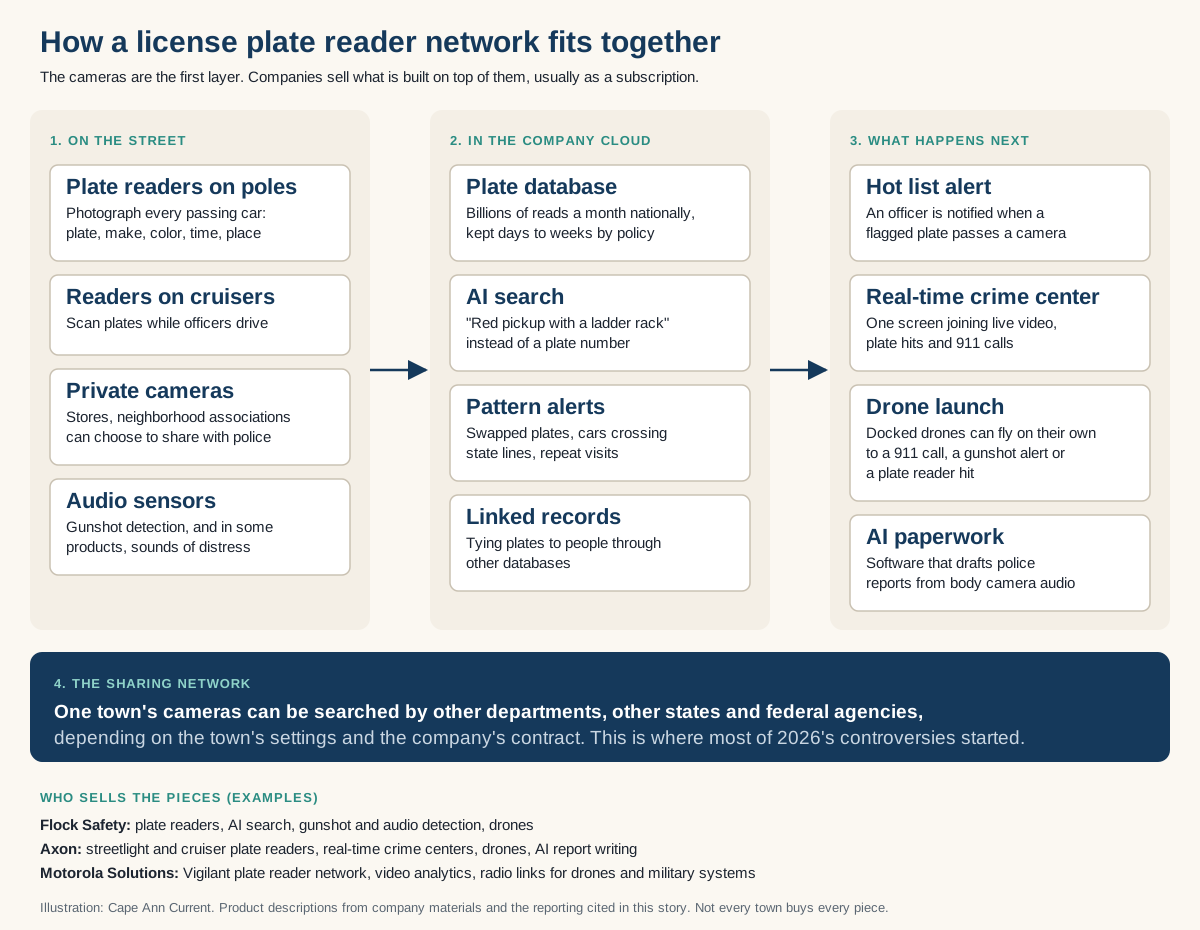
The companies are spending to shape the rules. Federal lobbying records show Flock alone spent $840,000 lobbying Congress and the White House in 2025 and $430,000 in the first half of this year. OpenSecrets found the company has spent $169,000 lobbying in Massachusetts alone since January 2025, second only to California. The Electronic Frontier Foundation argues the companies bundle cameras, drones and AI into subscriptions that are hard to leave. Supporters, including police officials, say the tools have found missing people and solved crimes that would not otherwise have been solved.
The state of the law
Massachusetts has no law on plate readers. A bill, H.3755, would keep plate data for 14 days unless tied to a criminal investigation, bar selling it and limit sharing to court proceedings. The Transportation Committee endorsed it in March. It has been in the House Ways and Means Committee since, and formal sessions have ended for the year. In September a Suffolk Superior Court judge ordered the State Police to disclose where its own readers are and its search records.
What a town would have to decide
If plate readers come up on Cape Ann, from any seller, these are the questions other communities have had to answer:
Is there a problem here the cameras would solve, given local crime numbers? Would the town own the cameras and the data, as Salem now does, or rent them from a company? How long is the data kept, and who decides? Which outside agencies can search it, and can sharing outside Massachusetts be turned off? Who audits officers' searches, how often, and has the audit process been bargained with the union? Will the public see camera locations, retention and sharing? Does the city council or select board vote on the contract and on any new feature, such as drones or AI search? What does it cost each year, and what happens to the data if the town walks away?
An open question for Cape Ann
None of the four communities has put plate readers on its agenda, and none has a public policy for them. If that changes, the questions above are the ones to ask. Town and police officials are welcome to answer them here: write to [email protected] and we will add their responses.
See the cameras near you
A volunteer project called DeFlock maps plate reader cameras reported by the public. Here is its map of Cape Ann and the North Shore. The map is crowd sourced: it can miss cameras, and it sometimes includes cameras that are not police plate readers, so treat it as a starting point, not an official count.
What do you think?
Should Gloucester, Rockport, Essex and Manchester-by-the-Sea use license plate readers, and if so, with what rules? Tell us in Crosscurrents, our reader voice column, with the topic "license plate readers." An editor reads every entry, and we will publish a selection of residents' views.
Sources
- SourceACLU of Massachusetts: Local leaders are saying no to Flock (tracker, updated Sept. 29, 2026)
- SourceACLU of Massachusetts data analysis: Flock gives law enforcement all over the country access to your location (Oct. 7, 2025, updated Feb. 26, 2026)
- RecordMassachusetts Legislature: H.3755, An Act establishing driver privacy protections, bill history
- RecordCity of Cambridge: Statement on the Flock Safety ALPR contract termination (Dec. 10, 2025)
- RecordFlock Safety: Does Flock share data with ICE? (Jan. 6, 2026)
- RecordFlock Safety transparency portal, Beverly Police Department
- SourceNBC Boston: Beverly debates use of AI powered Flock cameras (Apr. 22, 2026)
- SourceGBH News: State lawmakers look to put guardrails on Flock (Sept. 9, 2026)
- SourceBoston.com: Lowell, Methuen suspend use of Flock cameras (Sept. 24, 2026)
- SourceNPR: Cities cancel Flock contracts over immigration and surveillance concerns (Feb. 17, 2026)
- SourceWashington State Standard: Washington adds safeguards for Flock cameras (Mar. 30, 2026)
- SourceTexas Tribune: Abbott orders pause on state money for Flock cameras (Aug. 28, 2026)
- SourceNBC Chicago: Illinois finds Flock violated state law by sharing data with Customs and Border Protection (Aug. 25, 2025)
- SourceAxios Boston: Flock cameras in Massachusetts (Sept. 14, 2026)
- SourceBoston.com: Where Mass. cities and towns stand on Flock cameras (Sept. 13, 2026, map data updated about Sept. 30)
- SourcePatch: Beverly's license plate camera merits debated at City Council meeting (Apr. 22, 2026)
- SourcePatch: Salem ends Flock camera contract (July 23, 2026)
- SourceBoston Globe: Flock misuse cases in Massachusetts (Aug. 21, 2026)
- SourceBoston Globe: Lynn police and Flock cameras (Aug. 20, 2026)
- SourceBoston.com: More Mass. police officers placed on leave over alleged Flock misuse (Aug. 20, 2026)
- SourceWHDH: Two Lynn police officers on administrative leave (Aug. 2026)
- SourceSwampscott Tides: Swampscott officer on paid leave as department investigates Flock system use (Sept. 2026)
- SourceDaily Item: Swampscott officer put on leave following Flock investigation (Sept. 4, 2026)
- SourceWHAV: Methuen ends use of Flock Safety cameras (Sept. 23, 2026)
- SourceBoston 25: Methuen ends use of Flock Safety cameras over data concerns (Sept. 23, 2026)
- SourceWHAV: Haverhill council debates security vs. surveillance cameras (Aug. 11, 2026)
- SourceNews Link Live: Haverhill moves to regulate use of Flock cameras (Aug. 13, 2026)
- RecordFBI Crime Data Explorer: agency data for Gloucester, Rockport, Essex and Manchester police, 2022 to 2025 (refreshed Sept. 15, 2026)
- RecordMassachusetts State Police CrimeSOLV crime overview, Gloucester 2025
- RecordFBI: Officers Killed and Assaulted in the Line of Duty, 2025
- RecordU.S. Department of Justice, CrimeSolutions: License plate recognition technology as a crime deterrent (rated Ineffective)
- RecordNational Institute of Justice: Impacts of a large scale license plate reader deployment on criminal investigations (Koper and Lum)
- SourceKoper, Lum, Wu et al., Journal of Experimental Criminology (2022)
- SourceCity Journal: Mourtgos and Adams on their Flock data study (Aug. 24, 2026)
- RecordU.S. Department of Justice: Artificial Intelligence and Criminal Justice, final report (Dec. 3, 2024)
- RecordWhite House: Initial rescissions of harmful executive orders (Jan. 20, 2025)
- SourceCBS News: Justice Department announces law enforcement grants (Apr. 2026)
- SourceBiometric Update: Flock's nationwide surveillance network faces mounting scrutiny (Sept. 2026)
- SourceFirst Alert 4: Flock concedes privacy shouldn't depend on commercial incentives, letter to Sen. Hawley (Sept. 23, 2026)
- RecordSen. Ron Wyden: letter to the FTC on Flock (Nov. 3, 2025)
- RecordU.S. Senate Lobbying Disclosure: Mercury Public Affairs for Flock Safety, Q2 2026
- SourceOpenSecrets via News From The States: Flock's state and federal lobbying (Aug. 31, 2026)
- SourceBloomberg: Andreessen leads funding valuing Flock Safety at $7.5 billion (Mar. 5, 2025)
- SourceFortune: Flock, the $8 billion startup (Aug. 24, 2026)
- RecordFlock Safety: Drone as First Responder product page
- SourceEFF: Beware the bundle (May 2025)
- SourceEFF: Drone as first responder programs, 2025 in review
- Source404 Media: Cities are ditching Flock, immediately replacing it with Axon license plate readers (Aug. 6, 2026)
- SourceWBUR: Flock and the Boston police pilot, surveillance technology report (Sept. 14, 2026)
- RecordFraternal Order of Police: Who the Flock do you think you are? (Aug. 21, 2026)
- SourceIPVM: Police union attacks Flock (Aug. 21, 2026)
- RecordNational Sheriffs' Association: Joint law enforcement statement on ALPR (Aug. 25, 2026)
- RecordIACP: Statement on the responsible use of automated license plate readers (Aug. 20, 2026)
- SourceNBC Washington: DC police union says department needs more guardrails for Flock camera use (Sept. 10, 2026)
- SourceThe Record: DC police union opposes Flock use probing officers (Sept. 2026)
- SourceOhio Capital Journal: Ohio attorney general, police union want punishments for Flock misuse (Sept. 21, 2026)
- SourceNBC Boston: As officers face misuse allegations, Massachusetts departments rethink Flock (Aug. 2026)
- SourceWBUR: Boston police body camera pilot overview (Sept. 12, 2016)
- SourceBoston Magazine: Judge rules on Boston police body cameras (Sept. 9, 2016)
- SourceWBUR: Boston body camera final report (Aug. 2, 2018)
- RecordMassachusetts Law Enforcement Body Camera Task Force final report (Aug. 2, 2022)
- SourceACLU (Jay Stanley): Police body mounted cameras, with right policies in place, a win for all
- SourceEFF: The human toll of ALPR errors (Nov. 1, 2024)
- RecordACLU of Massachusetts: Use of automatic license plate readers, public records (EOPSS grant files)
- RecordEOPSS: Gloucester Police Department FFY2011 ALPR grant application
- RecordEOPSS: ALPR grant award letters, including Gloucester (Feb. 7, 2011)
- RecordGloucester City Council minutes (Oct. 10, 2023)
- RecordTown of Essex 2025 Annual Report
- SourceDeFlock The USA: Gloucester, Mass. (updated Sept. 30, 2026)
- RecordMourtgos and Adams, Automated License Plate Readers, Vehicle Theft, and Clearance (CrimRxiv working paper, Aug. 16, 2026)
See something wrong? Email [email protected]. Read our standards and corrections policy.