
Gloucester keeps the same tax split for homes and businesses, 8 to 1, after a push for a single rate fails
The City Council set the fiscal 2027 tax shift at 1.03 on Oct. 27, which puts the estimated rates at about $9.03 per $1,000 for homes and $9.33 for businesses, both lower than this year. The council also heard that the $206 million sewer plant upgrade will run to 2030 and accepted a $132,000 HarborWalk grant over one objection.

· Wednesday, October 28

Trust Check: Checked against public records
Gloucester homeowners will pay the same share of the city's property tax as this year. The City Council voted 8 to 1, from the meeting video, on Tuesday, Oct. 27, to keep the 1.03 shift onto business property for fiscal 2027, after a motion to charge every class the same rate failed 2 to 7.
The vote came after a public hearing where four speakers asked the council to keep or shrink the shift and one asked it to go the other way. All nine councilors were present. Council President Tony Gross ran the meeting.
What happened
- The council adopted a residential factor of 0.9973, the same 1.03 shift the city has used since fiscal 2017, by a vote of 8 to 1, from the meeting video. The estimated rates are about $9.03 per $1,000 of value for homes and $9.33 for commercial, industrial and personal property, down from $9.31 and $9.61 this year, because values rose.
- Ward 2 Councilor Dylan Benson moved to set a single rate of $9.05 for every class. That failed 2 to 7, from the meeting video.
- The city's engineers said the secondary treatment upgrade at the Essex Avenue sewer plant began in August and should finish at the end of 2030, paid for mostly with $206 million in low interest state loans.
- A $132,000 state grant for downtown signs and the HarborWalk passed 8 to 1 after Councilor at large Patti-Ann Page called the plan a threat to the working waterfront.
- The council dropped the newspaper notice rule for fee changes, withdrew a coastal lot size change, set a Dec. 8 hearing on multifamily lot rules downtown and confirmed Angela Sanfilippo to the Fisheries Commission.
The tax split
Principal Assessor Nancy Papows told the council that the state approved the city's fiscal 2027 values and new growth on Sept. 17. Homes now make up 91.7 percent of the city's $12.5 billion taxable value, and commercial, industrial and personal property (CIP) 8.3 percent. The city's taxable value rose close to 7 percent in a year. Single family homes rose 7.37 percent in value, apartments 12.42 percent, condominiums 1.27 percent and two and three family homes close to 4 percent. Commercial values rose close to 6.5 percent and industrial just over 5.5 percent.
The council's job each fall is to pick a residential factor, which decides how much of the levy each class pays. A factor of 1 means one rate for everyone. The total levy does not change. The maximum allowable levy for fiscal 2027 is $113,667,604, which works out to $9.05 per $1,000 at a single rate. The state allows a shift of up to 1.5, which would put the business rate at $13.58.
Papows said the median single family home is now valued at $775,500 and the average at $1,099,345. At the 1.03 shift, the owner of a $750,000 home pays about $15 a year less than at a single rate, and the owner of a business property worth the same pays $210 more. At the largest shift the home would save $300 and the business would pay $3,405 more.
Who spoke, and what the council said
A Wytham Street resident asked for a 1.05 shift. By his own figures from the assessors' reports, the average single family home's tax bill has risen about $2,070 over the last seven years while the average commercial bill rose $446 and the average industrial bill $221, because home values have climbed so much faster.
The chief executive of the Greater Cape Ann Chamber of Commerce asked the council to keep 1.03 or move toward one rate. He said the business share of the city's value keeps shrinking, now 8.3 percent, that businesses face the same rising costs as residents on a short seasonal economy, and that a bigger shift would fall on the small businesses that rent space. A Revere Street resident called the shift "robbing Peter" to pay Paul a few dollars. A Wheeler Street resident said a shift saves a homeowner $15 to $25 a year while adding $250 for a small business. An innkeeper who chairs the chamber's tourism council said tourism businesses are already under strain.
Benson said a 1.03 shift saves residents too little to matter, and a big shift would hurt business growth, so the city should go to one rate. "I would say that we should go to parity," he said. Ward 1 Councilor Scott Memhard said he supported a single rate as fair and equitable.
Page said she would not support it. Businesses create jobs and support nonprofits and youth programs, she said, and a waterfront company she knows saw its electric bills rise $10,000 in a year from state distribution charges. Councilor at large Jason Grow said home values have gone from $7.2 billion to $11.5 billion in six years while business values have stayed flat, so homeowners are the ones carrying the increases. He said he would prefer 1.05 and a long term goal of a 90 to 10 split, but would accept 1.03 for this year. Grow also said the way to help small business is lower rents for the empty storefronts downtown.
The single rate amendment failed with 2 votes in favor and 7 opposed. The council then adopted the 1.03 shift, 8 to 1.
By the numbers: the tax split, this year and next
From the Board of Assessors' fiscal 2027 tax classification packet (Oct. 27, 2026) and the fiscal 2026 figures in the same packet. Rates are per $1,000 of assessed value. Fiscal 2027 rates are estimates until the state certifies the recap.
| Fiscal 2026 (this year) | Fiscal 2027 (voted Oct. 27) | |
|---|---|---|
| Shift onto business property | 1.03 | 1.03 |
| Rate at a single factor | $9.34 | $9.05 |
| Residential rate | $9.31 | about $9.03 |
| Commercial, industrial and personal property rate | $9.61 | about $9.33 |
| Residential share of taxable value | 91.65% | 91.70% |
| Maximum allowable levy | not in the packet | $113,667,604 |
Rates fall while bills can still rise because assessed values went up. A home assessed at $750,000 would owe about $6,772 at the new residential rate.
Try it: your Gloucester bill at the new rate
Enter the assessed value from your tax bill to compare this year's rate with the one the council voted Monday.
At $750,000, the same home would owe about $210 less a year at the new rate. Fiscal 2027 bills use new assessed values, so a real bill will change by a different amount.
Rates from the assessors' packet for the Oct. 27 hearing. The fiscal 2027 rates are estimates until the state certifies them. Compare all four Cape Ann towns in our property tax calculator.
The sewer plant: $206 million and four more years
DPW Director Michael Hale introduced Eric Kelley of Apex, the city's owner's project manager, and Bob Parsons of Tetra Tech, the design engineer, for an update on the secondary treatment upgrade at the Water Pollution Control Facility on Essex Avenue.
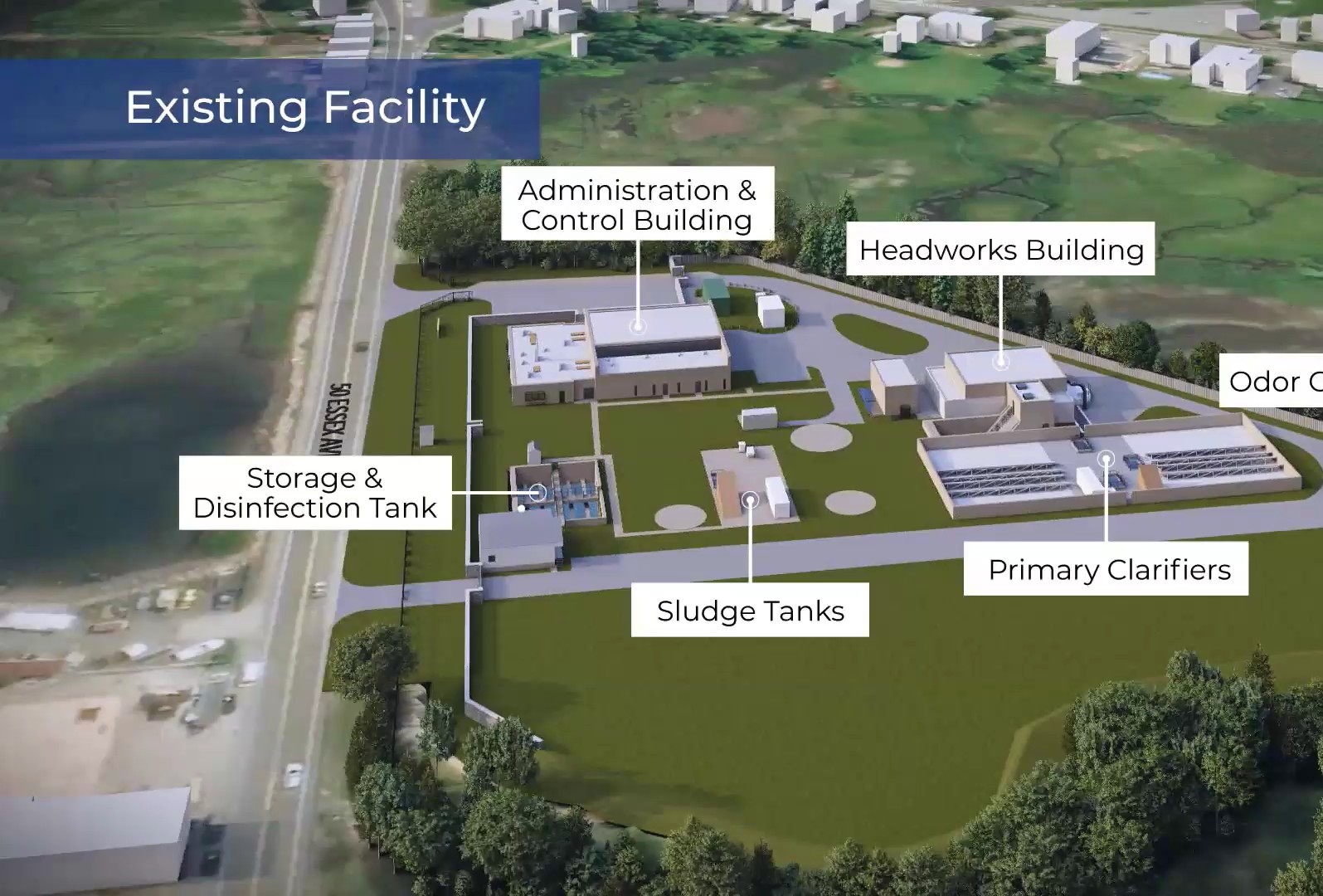
The plant was built in the early 1980s as an enhanced primary plant and has run under a waiver from full secondary treatment since the early 1990s, Kelley said. The federal permit issued in 2021 and a consent decree finalized in May 2023 require the upgrade. The city hired MWH Constructors as construction manager at risk, the method used for the schools, the police station and the library. Active construction began in August. The contractor's schedule has construction ending at the end of 2030, with the new liquid treatment process starting up around the end of 2029.
Parsons said the city has $5 million in federal EPA grants, two MassWorks grants of $500,000, a new $5 million MassWorks grant announced recently, a small state earmark and about $10 million in federal pandemic recovery money. The main source is $206 million in state revolving fund loans, in four pieces of about $50 million, with the first approved this month. As an environmental justice community the city gets a better rate and some principal forgiveness, Hale said, but the amounts are not known until each loan closes.
Hale said the project was estimated at $65 million in 2012 or 2013, and there are no $10 million or $100 million grants to chase. "Delays cost money," he said. He called it probably the biggest construction project the city's public works department has ever taken on.
Councilors asked about odor, cost and security. A temporary carbon odor control system will run during construction, Kelley said. The earthwork and the deep foundations, hundreds of piles driven to hold the tanks down and up in soft ground, come to almost $33 million. Trade bids over the next three months should set a guaranteed maximum price by about January. On cyber security, the presenters said a primary treatment plant is not a prime target and the city is looking harder at its water system. Veolia, the plant's contract operator, just signed a new five year contract and sits in every construction meeting.
HarborWalk grant passes 8 to 1
The council accepted a $132,000 Massachusetts Downtown Initiative grant from the state's economic development office for a second phase of wayfinding signs and repairs to the HarborWalk. There is no local match, and the grant runs from Jan. 1, 2027 to April 30, 2028.
Page pulled the item from the consent agenda. She said the grant would bring more tourist signs, reflective plastic markers, small "popcorn" signs and ten art installations into a quarter mile of the state designated port area, which she called a rugged working waterfront that needs help, not "fairy dust." She also objected that the council and the public hear about grants only after the city applies for them.
The economic development coordinator said much of the project is not on the waterfront at all. Seven more signs, most of them arrows, would guide people arriving by train or down Washington Street toward downtown. On the HarborWalk, the signs on the 42 granite posts were installed in 2012 with a ten year life and many are unreadable, so they would be replaced. Flat thermoplastic markers on the sidewalk, designed through a public process that includes waterfront businesses, would show walkers where the route turns inland toward Main Street. Nothing would block trucks or boats, she said.
Ward 3 Councilor Marjorie Grace said the city must not repeat the plastic crosswalks that became slippery in the rain a few years ago. Ward 5 Councilor Sean Nolan asked that the next maps be oriented to where the viewer stands instead of north up.
Also decided
- Fee notices. The council voted 8 to 0 to delete the rule that fee changes be published in a local newspaper. City Clerk Grace Poirier said that has not happened in her time with the city, fees must already be posted on the city website, and the council still votes on every fee change. Page had left the meeting after the tax vote.
- Coastal lot sizes. Memhard withdrew his ordinance to double the minimum lot size per home in the RC-40 coastal district, without prejudice, 9 to 0. He said the residents who asked for it decided to withdraw it.
- Downtown multifamily lots. A proposed change to the dimensional rules for multifamily buildings in the Central Business District got a public hearing date of Dec. 8 and was sent to the Planning and Development Committee and the Planning Board, 9 to 0. The packet shows the proposal would cut the minimum lot area from 10,000 to 2,000 square feet and the lot area per unit from 2,500 to 500.
- Grants and donations. On its consent agenda the council accepted the other Budget and Finance items, including a $124,300 Housing Choice grant and donations to Veterans Services, the Archives and a police youth fishing program. The $14,000 Mass Cultural Council grant went back to the committee because of a voting problem there. A framed portrait of former City Clerk Joanne Senos was accepted for the clerk's office, 8 to 0 with one councilor recused.
- Appointment. Angela Sanfilippo was confirmed to the Fisheries Commission for a term ending Feb. 15, 2029, 9 to 0.
- Requests to the mayor. Grace asked for more speed enforcement after a run of crashes, including people hit by cars. Gross asked whether the council can regulate electric bikes. A councilor noted the new trash system is in its third or fourth week and seems to be working.
What was decided
- Residential factor 0.9973 (a 1.03 shift onto commercial, industrial and personal property) for fiscal 2027: 8 to 1, from the meeting video. An amendment for a factor of 1 failed, 2 to 7, from the meeting video.
- Massachusetts Downtown Initiative Capital Grant, $132,000: 8 to 1, from the meeting video.
- Delete the newspaper publication requirement from the fees ordinance: 8 to 0, one absent, from the meeting video.
- Withdraw the RC-40 lot size ordinance without prejudice: 9 to 0, from the meeting video.
- Set a Dec. 8 public hearing on the multifamily dimensional amendment and refer it to committee and the Planning Board: 9 to 0, from the meeting video.
- Consent agendas, including the Housing Choice grant and donations: 9 to 0, from the meeting video. Portrait donation: 8 to 0, one recused, from the meeting video.
- Angela Sanfilippo to the Fisheries Commission: 9 to 0, from the meeting video.
What happens next
- The assessors send the classification vote to the state. Tax rates become final when the Department of Revenue certifies the city's recap sheet, usually in December, and third quarter bills then show the new rates.
- The sewer plant's trade bids come in over the next three months, with a guaranteed maximum price expected around January. The narrated animation of the project is on the city website.
- The HarborWalk project starts with a public design process after Jan. 1.
- Tuesday, Nov. 10, 6:30 p.m.: next regular City Council meeting.
- Tuesday, Nov. 24: hearing on accepting Deacon Farm Lane as a public way.
- Tuesday, Dec. 8: hearings on the downtown multifamily lot rules and on Wheeler Street parking.
- Saturday, Dec. 12: Middle Street Walk, with street closures approved.
Where to find the records
- Agenda for the Oct. 27 meeting and the packet, which includes the assessors' tax classification packet.
- October 2026 Past Meetings, where the city posts the Zoom recording. Minutes will be posted in the Archive Center.
- City Council page, with members and committees.
Earlier coverage: Gloucester City Council Tuesday: public hearing on the tax split (Oct. 25), the agenda for this meeting; Gloucester committee backs keeping the same tax split for homes and businesses (Oct. 24), the committee vote and the grant debate; Gloucester council committee drops the coastal lot size change (Oct. 24); and Gloucester's fiscal 2027 budget (Oct. 5).
How we did this: Cape Ann Current watched the meeting online on the city's recording. Votes are as heard on the recording and are labeled from the meeting video until the council's minutes confirm them. These are our meeting notes, not the council's minutes.
Sources
- RecordCity of Gloucester: City Council meeting recording, Oct. 27, 2026 (Zoom, on the October 2026 Past Meetings page)
- RecordCity of Gloucester: City Council agenda, Oct. 27, 2026
- RecordCity of Gloucester: City Council packet, Oct. 27, 2026 (Board of Assessors, Tax Classification Information for Fiscal Year 2027)
- RecordCity of Gloucester: City Council page (members)
Do you trust this story?
See something wrong? Email [email protected]. Read our standards and corrections policy.