
Data centers and plate reader cameras: Cape Ann's four towns have no rules on either, and a Manchester comment raised the question
No Cape Ann town names data centers or license plate readers in its code. Here is what other Massachusetts and New England places are doing, what data centers mean for water in a drought, electricity and other resources, the arguments on each side, and a poll on whether your town should write rules first.

· Sunday, November 8

Trust Check: Checked against public records
Two technology questions are moving through town halls across New England: where large data centers can be built, and how police can use automated license plate readers such as Flock cameras. No Cape Ann town has a rule that names either one. Essex's Planning Board has drafted a data center pause for the Nov. 16 Fall Town Meeting. This story lays out what Gloucester, Rockport, Essex and Manchester-by-the-Sea have on the books, what other places are doing, the arguments on each side, and a poll asking whether each town should set rules now, before a developer or vendor arrives with money and a deadline.
Why we ran this. A comment at the Manchester-by-the-Sea Planning Board meeting on Oct. 13 prompted this story. During a discussion of the board's project list, a member asked to add data centers so they are banned by name, and others noted that data centers are already not allowed under the town's zoning. That raised a question the Current had not seen answered for any Cape Ann town: what do the codes actually say, and what are other places doing? The Current checked all four towns and the results are below. The poll at the end asks readers what they think.
Where the four towns stand
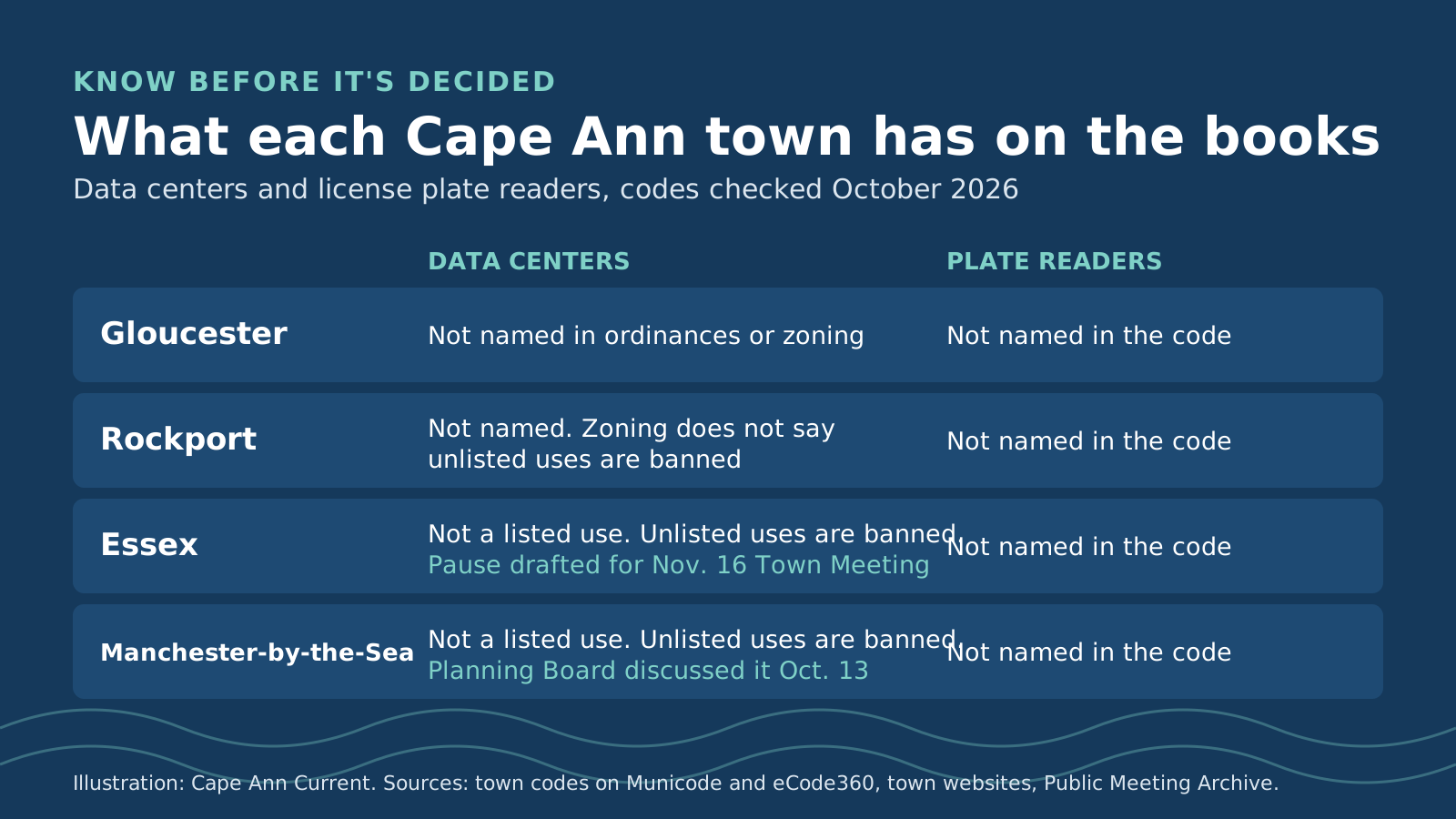
The Current checked each town's current codes and its public meeting archive.
| Town | Data centers | License plate readers |
|---|---|---|
| Gloucester | Not mentioned in the ordinances or zoning (zoning through Ord. 2025-233, Sept. 12, 2025) | Not mentioned in the code. A city councilor said in June 2024 that police parking enforcement uses plate readers; the vendor was not named |
| Rockport | Not mentioned. Not in the zoning use table, and no line bans unlisted uses (zoning through Sept. 8, 2025) | Not mentioned |
| Essex | Not a listed use. The zoning bylaw prohibits any use it does not list (bylaws v26.1, July 20, 2026) | Not mentioned |
| Manchester-by-the-Sea | Not a listed use. Zoning says any use not listed is prohibited (zoning bylaw, April 27, 2026) | Not mentioned |
Two items are pending. The Essex Planning Board drafted a temporary data center moratorium and a definition of "data center" for the Nov. 16, 2026 Fall Town Meeting. The Sept. 2 draft ran through Jan. 1, 2028, and the Board of Selectmen discussed the wording Oct. 5. The final warrant still needs to be checked. In Manchester, a Planning Board member asked on Oct. 13 to add data centers to the board's project list so they are banned by name, while others noted they are already not allowed. (Read what the Essex Planning Board recommended Oct. 21.)
A Boston.com survey of Massachusetts communities, updated at the end of September, did not list any Cape Ann town as a Flock user. The Current has not yet asked the four police departments whether they use plate readers from any company.
"Not listed" is not the same as "banned" in every town. Rockport's use table does not say unlisted uses are prohibited, and in Essex and Manchester someone could argue a data center fits an existing category.
Data centers: a wave of local pauses, and a few welcomes
The state. Gov. Maura Healey signed an executive order Sept. 8, 2026 that requires local approval before a proposed data center can move forward with state permits. Projects with peak electricity demand above 25 megawatts must meet the administration's framework, which includes a community benefits agreement with the host town. The order also creates a Ratepayer Protection Fund for projects that do not bring their own clean energy, and bars non-disclosure agreements between state agencies and data centers. State guidance for towns is due by the end of the year. Healey had already paused applications for the state's data center sales tax exemption in June. Massachusetts has roughly 50 data centers, most in Greater Boston.
Massachusetts towns. By mid-September at least 16 communities had proposed or approved moratoriums or limits, according to data compiled by Hunneman and reported by Banker & Tradesman.
| Place | Outcome | What it did | Date | Source |
|---|---|---|---|---|
| Mansfield, Mass. | Limits | Adopted a dedicated data center zoning bylaw that limits size and location, caps noise at 50 decibels by day and 45 at night, and issues five-year permits that depend on reporting of power, water and noise | May 5, 2026 | Boston.com, Boston Globe |
| Holyoke, Mass. | Ban | Zoning ordinance banning data centers, with an exemption for the Massachusetts Green High Performance Computing Center; it stopped a proposed 20 megawatt project | 2026 | The Shoestring |
| Westfield, Mass. | Pause | One-year moratorium on new data centers, after the city approved a $4 billion campus in 2021, later backed by a tax agreement, that has not broken ground | July 2026 | WAMC, Banker & Tradesman |
| Shutesbury, Mass. | Pause | One-year moratorium through June 20, 2026; the Attorney General's office found it legitimate because it was limited in time and scope | Sept. 2025 | Attorney General letter |
| Leominster, Mass. | Pause | One-year moratorium on data centers and battery storage sites | 2026 | MassLive via Fire Engineering |
| Southbridge, Mass. | Proposed or vetoed | Planning Board recommended a moratorium citing the local aquifer | Sept. 17, 2026 | Town document |
| Maine (state) | Proposed or vetoed | Legislature passed a moratorium on data centers over 20 megawatts; Gov. Janet Mills vetoed it over an exemption for a project in Jay, then signed a bill barring data centers from state business tax incentives | April 24, 2026 | Bangor Daily News, Bloomberg Law |
| New Hampshire (state) | Proposed or vetoed | Gov. Kelly Ayotte said she opposes a hyperscale data center proposed in Bow and plans to propose a statewide moratorium in her budget | Sept. 2, 2026 | Vermont Public |
| Groton, Conn. | Limits | One-year moratorium, then rules that cap data centers at 12,500 square feet after proposals for two 250,000 square foot centers; a landowner is suing the town | Date not confirmed | Data Center Dynamics |
Why these places: they are the Massachusetts communities and New England governments with a documented vote or decision, chosen to show the range from pauses to size caps to bans. Missing data: exact dates for Holyoke, Leominster and Groton were not confirmed in the sources, and the Attorney General's review of newer bylaws such as Mansfield's has not been checked.
Who is welcoming them. Not everyone is closing the door. Westfield's officials approved the Servistar campus, which could total $4 billion, in 2021 and later backed it with a tax agreement. Supporters pointed to 1,800 to 2,000 construction jobs over eight to ten years and more than $1.2 million in city tax revenue within three years. In Jay, Maine, the town government backs a $550 million data center at a closed paper mill that Gov. Mills said would create more than 800 construction jobs and at least 100 permanent jobs. Mansfield and Groton regulate rather than ban outright. An industry group said Maine's moratorium would signal that the state is closed for business. Healey has said she wants Massachusetts to build data centers in a way that does not harm residents.
The water question
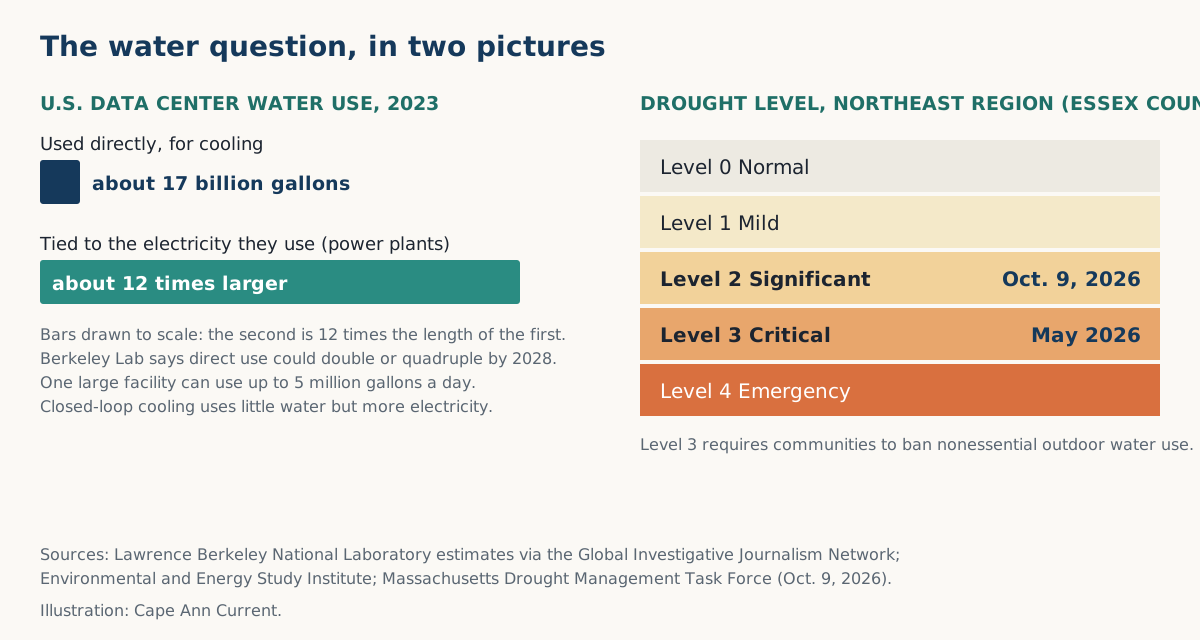
Data centers use water in two ways: directly, to cool equipment, and indirectly, through the power plants that supply their electricity. The Lawrence Berkeley National Laboratory estimated that U.S. data centers directly consumed about 17 billion gallons in 2023, a figure that could double or quadruple by 2028, and that water tied to electricity generation was about 12 times larger.
How much a single facility uses depends on its cooling design. Evaporative cooling consumes water as it turns to vapor. Closed-loop systems circulate the same fluid and use little water, but need more electricity. One large facility can use up to 5 million gallons a day, according to the Environmental and Energy Study Institute, about what a town of 10,000 to 50,000 people uses. A proposed closed-loop campus in Missouri says it would use about as much as 54 homes. Companies rarely publish exact figures.
Cape Ann is in a drought. On Oct. 9 the state moved the Northeast Region, which includes Essex County, to Level 2, Significant Drought. In May the region had been at Level 3, Critical Drought. Under the state plan, Level 3 requires communities to ban nonessential outdoor water use. In Attleboro, which is weighing a temporary ban, a water official told the City Council the city's surface water system could not handle even a small data center. The Current has not yet obtained how much spare capacity each Cape Ann water system has.
Electricity, air, land and noise
Water is one of several things a data center uses. The others are electricity, air, land and quiet.
Electricity. ISO New England, which runs the regional power grid, said in May that large users of power, a category that includes data centers, are not yet driving demand growth in the region. Its 2026 forecast lists two proposed large projects in formal study, with a combined peak demand of up to 285 megawatts: a 200 megawatt data center in the northeastern Massachusetts and Boston zone, and an 85 megawatt electrification project in Connecticut. Neither is expected to affect system demand before winter 2027 to 2028. After discounting for projects that may not be built, ISO-NE forecasts the category adding about 110 megawatts to peak demand in the 2030s and about 130 megawatts in the 2040s.
The cost to customers is debated. The Green Energy Consumers Alliance, a Massachusetts nonprofit, wrote in September that bills can rise in two ways: through new wires and substations, and through higher wholesale prices when demand grows. It said the region has the fewest safeguards against the second, and that new data center demand has raised prices in the mid-Atlantic grid by "tens of billions of dollars," citing Utility Dive. The group says New England has been partly shielded so far because data centers favor cheap power. A House version of the state's energy affordability bill includes a rate class for very large users, and a House and Senate committee is working out the final bill. The Current has not yet asked the electric utilities serving Cape Ann how much new demand their local lines could carry without upgrades, or who would pay for them.
Air and backup power. Data centers keep generators, usually diesel, for outages. In Virginia, state officials count about 9,000 of them, about 4,700 in Loudoun County. A Virginia legislative research report estimated that in a worst case they could release 9,000 tons of nitrogen oxides, about half of what all sources in Northern Virginia typically emit in a year. In Massachusetts, the Green Energy Consumers Alliance says neither the state's June framework nor the Senate's version of the energy bill bans fossil fuel backup generators.
Land and noise. These are the resources towns control most directly through zoning. Groton, Conn. capped data centers at 12,500 square feet after proposals for two 250,000 square foot centers. Mansfield's bylaw caps noise at 50 decibels by day and 45 at night and ties its five-year permits to reporting on power, water and noise. Both are in the table above.
Plate readers: towns pull back, state law is missing
For the research behind the plate reader question on the North Shore, see License plate readers and Cape Ann.
Flock cameras read license plates and other vehicle features and let police search the results, sometimes across departments. Roughly 100 Massachusetts police departments have used them. A Boston Globe tally found about 40 communities had paused or stopped using Flock in the past year.
| Place | Outcome | What happened | Date | Source |
|---|---|---|---|---|
| Cambridge | Ended | Paused, then ended its contract after Flock installed two more cameras the city says it did not know about | Oct. to Dec. 2025 | Boston.com |
| Watertown | Ended | Canceled its contract | Jan. 2026 | GBH |
| Salem | Ended | Ended its contract over data protection concerns | July 2026 | Boston.com |
| New Bedford | Paused | Paused after an officer was accused of using the system to track an ex-partner; the City Council sent a ban proposal to its ordinance committee | Aug. 2026 | Boston Globe, WJAR |
| Methuen | Ended | Ended its contract after an audit found data was not protected well enough | Sept. 23, 2026 | Boston.com |
| Milton | Ended | Select Board voted to stop using the cameras | Oct. 6, 2026 | Boston 25 |
| Quincy | Kept | Keeps them; limited access to 47 investigators after an audit showed nationwide sharing; the chief says they have helped solve kidnappings and sexual assaults | 2026 | Boston 25 |
| Beverly | Kept | Keeps four cameras after a City Council committee hearing | April 2026 | NBC Boston |
| Douglas | Ended | Removed them while saying they helped solve several serious crimes, citing a divisive atmosphere | Aug. 2026 | Boston 25 |
Why these places: they include the nearest North Shore communities, towns that ended contracts, and towns that kept the cameras, so readers can see both sides. Missing data: Quincy's exact decision date was not shown in the source, and camera counts are not published for most towns.
Misuse and sharing. Officers in Stow, Lynn and New Bedford were placed on leave over allegations the system was used improperly. A Suffolk Superior Court judge ordered State Police to release their camera locations and search logs, after an ACLU of Massachusetts lawsuit. On Aug. 13, Flock said it would cut its default retention from 30 days to seven, require a case number for searches, and make its audit tool mandatory. Departments can still set their own retention, and the ACLU called the changes a response to a public relations problem.
The law. Massachusetts has no statute on plate readers. H.3755, filed by Rep. Steven Owens of Watertown, would require a warrant before police obtain plate data from another entity and limit retention to 14 days. The House members of the Transportation Committee endorsed it 11 to 0 in March, and it has sat in House Ways and Means since March 23. Advocates note that Massachusetts is among the only New England states without statewide limits. New Hampshire, Maine and Vermont each have laws governing plate readers. The Massachusetts Municipal Association has offered towns no guidance on Flock because, its director said, no one had asked.
The case for and against writing rules first
For acting before a proposal arrives - A town sets the terms when no one is waiting for an answer. Mansfield officials said they wanted to avoid being caught unprepared, and they acted without a project in hand. - Definitions matter. Many zoning codes do not define a data center, and a proposal can expose that gap quickly. A written rule also settles whether a 5 megawatt facility is treated like a 200 megawatt campus. - Water, power and noise limits are easier to set before a developer's lawyers and consultants are involved. Westfield approved a tax deal first and began pausing new projects only after local opinion shifted. - For plate readers, rules on warrants, retention, sharing and audits are easier to set before contracts, grants and department habits take hold.
For waiting, or for narrower action - Tax revenue and jobs are real. Jay, Maine, and Westfield officials made that case, and the industry says pauses discourage investment. - Law limits blunt tools. The Attorney General's Shutesbury letter treated a temporary moratorium as valid because it was limited in time and scope and tied to study. A permanent ban is a different question, and Groton faces a lawsuit over its limits. - A broad ban can catch small facilities. Groton set a size threshold, and Holyoke exempted an existing research center. - The governor's order already gives towns a veto over projects above 25 megawatts. Smaller projects and plate readers are not covered by that order. - Police chiefs in Quincy and Douglas say plate readers solve serious crimes, and Flock says its technology contributes to many investigations. Supporters argue rules in department policy can address misuse without a ban. - A bylaw takes time, legal review and town meeting votes, and a future state law could change what towns are allowed to do.
Questions worth asking
Data centers 1. How does each town's code define a data center, and does that definition separate a small server room from a hyperscale campus? 2. How many gallons a day could each town's water system spare in a Level 2 or Level 3 drought, and who decides? 3. If Essex passes a moratorium, what will the study cover, who will do it, and what happens in January 2028? 4. What would a community benefits agreement need to include here, and who would negotiate it for the town? 5. Would a ban on the use, or strict limits on size, water, power and noise, protect the town better? 6. An executive order can be changed by a future governor. A bylaw needs town meeting to change. Does that difference matter?
Plate readers 7. Which Cape Ann departments use plate readers from any company, and what written policy governs them? 8. Who can search, who can receive the data, how long is it kept, and who audits the searches? 9. Should those rules sit in an ordinance voted by the elected body, or in a department policy? 10. If the Legislature passes H.3755 or something like it, would a town still need its own rule? 11. What local crime problem would a camera address, and what evidence supports it? 12. How much more electricity could the local lines carry without upgrades, and who would pay for the upgrades if a large user asked for them?
Cape Ann Poll: should your town set rules first?
One vote per connection, checked on our server. Results show as soon as you vote, by town, with a margin of error that updates as votes come in. This is not a scientific survey, and the poll explains why. The Current publishes totals by town only.
How we compiled this
The Current reviewed the current codes of the four towns on Municode, eCode360 and the town websites, the Public Meeting Archive, state and court records, and reporting from the outlets listed below. Statements by officials and companies are reported as their positions. The Current takes no position on any town's rules. Corrections and answers from town officials and police departments are welcome at [email protected].
Sources
- SourceBoston Globe: Healey signs executive order requiring local approval for data centers (Sept. 8, 2026)
- SourceWBUR: Proposed data centers need local approval under Healey order (Sept. 8, 2026)
- SourceMassachusetts Municipal Association: Executive order requires data centers to get local approval
- SourceBoston.com: Mansfield data center zoning bylaw (May 13, 2026)
- SourceBoston Globe: Massachusetts officials set limits on AI data centers (Sept. 24, 2026)
- SourceBanker & Tradesman: Will Mass. take a pass on data centers?
- SourceThe Shoestring: Data center discontent reaches western Massachusetts (July 2, 2026)
- SourceWAMC: Pioneer Valley communities rally against data centers (July 13, 2026)
- RecordAttorney General letter on Shutesbury moratorium
- RecordSouthbridge draft data center moratorium (Sept. 17, 2026)
- SourceNBC Boston: Westfield campus and tax incentive
- SourceBangor Daily News: Mills vetoes Maine data center moratorium (April 24, 2026)
- SourceVermont Public: Ayotte opposes Bow data center (Sept. 2, 2026)
- SourceData Center Dynamics: Groton, Conn. blocks large-scale data centers
- SourceMassLive via Fire Engineering: Leominster moratorium
- SourceSun Chronicle: Attleboro eyes temporary ban on data centers
- RecordMassachusetts Drought Management Task Force: Drought conditions improve in Connecticut River Valley (Oct. 9, 2026)
- RecordMassachusetts drought page (May 22, 2026 Level 3 declaration)
- SourceLawrence Berkeley National Laboratory data center water estimates, as reported by the Global Investigative Journalism Network
- SourceEnergy Central: Data centers and water
- SourceBoston Globe: The public is increasingly livid about Flock (Oct. 1, 2026)
- SourceGBH: State lawmakers look to put guardrails on Flock (Sept. 9, 2026)
- SourceBoston 25: Milton votes to stop using Flock cameras (Oct. 8, 2026)
- SourceBoston 25: Debate over Flock cameras continues across the state
- SourceBoston.com: Auburn, Bellingham and Douglas join list of towns cutting ties with Flock (Aug. 26, 2026)
- SourceBoston.com: New Bedford suspends Flock (Aug. 11, 2026)
- SourceWJAR: Calls to remove Flock cameras grow in New Bedford (Aug. 25, 2026)
- SourceNBC Boston: State Police must disclose Flock camera locations
- SourceWashington Examiner: Flock CEO outlines policy changes (Aug. 13, 2026)
- SourceWaltham Times: Privacy concerns persist over Waltham's Flock cameras (June 28, 2026)
- SourceThe Shoestring: Automated license plate readers flock to western Massachusetts (Aug. 17, 2026)
- SourceTexas Policy Research: ALPR state models, citing NCSL (Sept. 2026)
- RecordISO New England: ISO establishes forecast framework for data centers, other large loads (May 18, 2026)
- SourceNew Project Media: ISO-NE debut large-load forecast shows dearth of data center projects
- SourceGreen Energy Consumers Alliance: Data centers in Massachusetts (Sept. 2026)
- SourceVirginia Mercury: Virginia regulators weigh expanded use of data centers' polluting generators (Dec. 16, 2025)
Do you trust this story?
See something wrong? Email [email protected]. Read our standards and corrections policy.