
Haffner's Way, Part 6: Energy North wants a road and two lots in Gloucester, and no one has said what they are for
The Lawrence fuel company wants approval for a private road and two industrial lots on the old Sargent Street junkyard. The application does not say what will be built. The only plan that did showed fuel tanks.

· Monday, November 16

Trust Check: Checked against public records
Energy North Inc., a Lawrence fuel company, wants the City of Gloucester to approve a private road and two industrial lots on 9.5 acres of the former Sargent Street junkyard, on contaminated fill beside a wetland. Nobody has said what the lots would be used for. The application names no use for either one. The only plan on record that does name a use is a 2023 layout with 190,000 gallons of fuel tanks, which the company's attorney says is off the table. This story lays out what the city's own records say, what they do not say, and what could settle the question.
Where things stand
- What is being askedApproval of a private road and two industrial lots on the old junkyard site off Sargent Street, over contaminated fill next to a wetland.
- What nobody has saidWhat the lots would be used for. The application says there are no known or proposed uses. The only plan that named one, in 2023, showed fuel tanks. Energy North's attorney told the Planning Board on Oct. 1 that plan is "off the table." Nothing is in writing.
- What happens nextAn outside review ordered by the Planning Board is not yet public. The Conservation Commission meets Nov. 18 and the Planning Board is expected to take the item up Nov. 19. No board has voted on the merits.
What is proposed and where
The filing on record is a two lot industrial subdivision on about 9.5 acres of a former junkyard at Sargent Street, Gale Road and Gloucester Avenue. It would be served by a new private road, Haffner's Way, of about 753 feet ending in a cul-de-sac, about 465 feet of it new. The land is zoned General Industrial. A public listing for the Sargent Street property shows 9.54 acres, an asking price of $1,750,000, and a status of "pending" (Raveis listing).
The road is the part now before the Conservation Commission. Its application, a Notice of Intent filed as number 028-3159, includes stormwater basins that let rain soak into the ground. Those basins would sit over soil that the city's minutes describe as contaminated (Conservation Commission minutes, Oct 7, 2026).
The project name is Haffner's Way, and it sits before two boards under two different names. At the Planning Board, Energy North Incorporated is the applicant for a definitive subdivision plan, heard Oct 1, 2026 under state subdivision law (Chapter 41, Section 81T). The agenda covers parcels on Sargent Street, Millett Street, Gale Road and Gloucester Avenue (Planning Board agenda, Oct 1, 2026). The Conservation Commission's Notice of Intent names Sargent Street Corp. Energy North also went to the Zoning Board in 2025 (minutes). A rescheduled hearing notice sent to Ward 2 residents and abutters, with the Ward 2 councilor as contact, says the application was submitted by Energy North Inc. on behalf of the property owner, Sargent Street Corp. Energy North has a purchase and sale agreement for the land, according to the application as reviewed by our desk.
Where the site is
Zoom and drag. Use the Aerial button to see the land, the rail line and the wetland, and Streets to see the road names and neighborhoods.
Parcel outlines (approximate)
Outlines: MassGIS property tax parcels. Aerial: MassGIS 2025. Streets: OpenStreetMap contributors. The proposed road and lot lines are in the application and are not drawn here.
Is the city being set up for a bait and switch?
The record cannot answer that. It does show why people are asking.
Here it would mean the city approves a road and two lots on the understanding that no fuel storage is planned, and a fuel facility is proposed later. Nothing in the record shows that is the plan, and the applicant's attorney has said it is not.
- The application names no use for either lot.
- The only plan on file that names a use is a 2023 fuel layout, and it is still attached.
- The road would be approved before any use is known.
- The attorney said on the record that a bulk fuel plant is "off the table."
- Any building would need its own Planning Board review.
- Work near the wetland needs the Conservation Commission and MassDEP.
The plain question underneath: what is the road for?
What the record shows
- The applicant. Energy North Inc., a fuel company, has a purchase and sale agreement for the land. Sargent Street Corp. is the owner.
- The 2023 concept. The company's own geotechnical report describes a redevelopment with an 80,000 gallon heating oil tank, a 20,000 gallon diesel tank and three 30,000 gallon propane tanks, 190,000 gallons in all. That report is Attachment B of the current application.
- Three routes in two years. Since early 2025 the company has tried a frontage variance (withdrawn April 2025), a plan to combine the parcels without subdivision review (withdrawn August 2025), and the subdivision now before the board. At the 2025 Zoning Board hearings it said there were no concept plans.
- The current plans. They show a road, drainage and two empty lots. The filing names no use. Its traffic study models a generic light industrial build out of two buildings.
- The commitment. On Oct. 1 the company's attorney said the fuel plan "could not be done on this two lot subdivision" and that a bulk fuel plant is "off the table." The draft minutes record it. Nothing is in writing.
Why residents and some board members are asking
- Approving the road and lots first leaves the use for a later, narrower review. One board member said that once the road is built, nobody can make the applicant undo it. The planning director called the traffic scenario light for a site this size and said it should be tested against more intense uses.
- The zoning allows nearly 100 uses, so approval of the lots does not narrow what could go there.
- The 2023 fuel layout is still in the application record, though not on the plans.
- Several speakers called the road a "Trojan horse" or "smoke and mirrors." Those are residents' characterizations, not findings.
What cuts the other way
- The applicant itself filed the 2023 report that describes the fuel layout. It did not hide it.
- The attorney made a specific statement on the public record, and the city's minutes capture it.
- The applicant says any building would need Planning Board site plan review, so a use would get its own public hearing, and the Conservation Commission and MassDEP would review work near the wetland and in the restricted soil.
- The record does not show whether the 2023 concept is abandoned, dormant or changed. The company has not said what it does want to build, and it is not required to at this stage.
The case for the project
- Vacant land with a cleanup problemRecords describe the site as inactive since 2014, after decades as a junkyard and landfill. The applicant says redevelopment under state oversight is the way the contamination gets addressed.
- Tax baseThe four parcels on the site that the assessor lists total about $1.12 million in assessed value for FY2026, which is roughly $10,800 a year in tax at the $9.61 commercial rate (our estimate, not the bills). Each $1 million of added assessed value would add about $9,610 a year at that rate. What would be built, and so what it would be worth, has not been stated.
- Local jobs and investmentSupporters point to local jobs and investment. Energy North's Haffner's brand lists a station in Gloucester on its website. Any jobs would depend on the use, and no figure is in the record.
- One conditional letterA Sept. 15 letter from the Cleveland Street Committee said it would accept redevelopment only with no connection to Sargent Street, a security fence and perimeter trees. A neighbor has since said the neighborhood does not support the project and that the letter was withdrawn. The public file through Oct. 15 holds no written withdrawal.
- What the applicant saysContamination would be handled under the land use restriction and a state cleanup plan, no wetland would be altered, stormwater would slightly reduce peak flows, and traffic from a light industrial build out would be minimal.
Energy North has not put jobs, investment or tax figures in the public record. Tax figures use the state parcel data and the FY2026 commercial rate, and assume the parcels are in the commercial class.
Mark your calendar
The wetland case is expected on Dec. 2. The Planning Board's Nov. 19 agenda continues its hearing to Dec. 3.
Dates and times come from the City of Gloucester calendar and agendas, checked Nov. 17. The Conservation Commission's revised Nov. 18 agenda asks to continue the Haffner's Way case to Dec. 2, and the city calendar lists a Conservation Commission meeting that day at 5:30 p.m. The Planning Board's Nov. 19 agenda (5 p.m., Rose Baker Center for Aging Well, second floor conference room) lists the Haffner's Way subdivision hearing as "to be continued to December 3, 2026." The city had not yet listed a Dec. 3 meeting, time or place. Call the Planning Division at (978) 325-5230 or check the city calendar before you go. End times are placeholders. Our guide to what to ask is Part 7.
Update, Nov. 17, 2026: The city posted the Planning Board's Nov. 19 agenda. It lists the Haffner's Way subdivision hearing as "to be continued to December 3, 2026." Anything in this story that says the board takes up the case on Nov. 19, or that its date is not yet posted, is out of date.
Questions for Energy North
The Cape Ann Current puts these questions to Energy North Inc., the applicant. The public record does not answer them.
- What do you plan to build on each of the two lots?
- What are your plans for continued investment in Gloucester and the surrounding area?
- How many new jobs do you anticipate in the area, and over what time frame?
- Will you put in writing, or record with the deed, a limit on what the lots can be used for, including bulk fuel storage?
- What community benefits are you willing to offer, such as a path, a fence or trees?
Energy North can answer at any time. The Current will publish its answers in full and attribute them to the company.
What would settle it
- A written statement from the applicant of its intended use.
- A condition of approval limiting use or barring bulk fuel storage.
- Removal of the 2023 fuel layout from the application, or an explanation of why it stays.
- A traffic study of more intense uses. Staff asked, and the applicant agreed to respond.
- Notice to abutters before any future use is proposed.
Residents asked for the first and last of these at the Oct. 1 hearing. As of Nov. 6 we found none of them in writing.
Timeline: what was filed, changed and withdrawn
Energy North has tried three routes to make this land buildable since early 2025. None of them named a use.
Contamination found in 2000 is closed out under a state cleanup program. A recorded restriction limits the land to industrial or commercial use that keeps the pavement intact, bars housing, schools and daycares, and requires a soil plan before digging.
Energy North's consultants drill test borings and draw a layout for the site with an 80,000 gallon heating oil tank, a 20,000 gallon diesel tank and three 30,000 gallon propane tanks, 190,000 gallons in all. It was never originally filed with the city. It is part of Energy North's Aug. 13, 2026 filing, so it was not withdrawn. It is the only plan on record that names a use.
First filing: a request to combine the five parcels into one 9.54 acre lot with Sargent Street frontage. No use is stated.
The Zoning Board hears a request for relief from the 65 foot frontage rule. The attorney says there are no concept plans. A board member says he is uncomfortable granting relief with no use. Continued to March 27.
City legal advice is read into the record: judge the request as if the use were the industrial use least compatible with homes. Continued to April 24.
The frontage request is withdrawn without prejudice, 4 to 0, after a board member became unable to vote on it.
The Planning Board accepts the withdrawal of the plan to combine the parcels. The company had asked on July 10 because the combination depended on the frontage relief it had withdrawn.
New approach: a two lot subdivision with a new street, filed as a preliminary plan. Two lots of about 2.1 and 6.6 acres, a cul de sac, two stormwater basins. No building, tank or use shown.
Revised plan names the road School House Road Extension, shows the full easement from Schoolhouse Road, measures it at 740 feet and asks for one waiver.
The Planning Board approves the preliminary plan with conditions, unanimously, in about 11 minutes on Zoom with no public comment. Conditions include a traffic study, subsurface data, stormwater calculations and a requirement to address the contamination.
Definitive plan filed as Haffner's Way: 753 feet, one stormwater basin instead of two, a sidewalk on one side. A traffic study assumes a made up 35,450 square foot light industrial build out. The filing says there are "no known or proposed uses." The 2023 fuel report is attached as subsurface data.
The planning director recommends an independent review of the whole application. The Health Department asks for an outside review of the road and stormwater design on contaminated fill.
The hearing cannot be held because of an error in the legal notice. It is pushed to Oct. 1.
Public hearing. Seventeen speakers, none in favor. The attorney says on the record the company will not build a bulk fuel plant there. One parcel is dropped because the seller does not own it. The board votes unanimously for an outside review paid for by the applicant and continues the hearing.
The commission votes 4 to 0 to hire its own outside reviewer for the road, which sits in the 100 foot buffer of a wetland. Continued.
Continued twice at the applicant's request with no hearing held. New date: Nov. 18.
The agenda lists the item as "requested to be continued to November 19." The board did so, 7 to 0, in an 11 minute meeting, and agreed to extend its deadline to act to Dec. 31. (Read our notes on the Nov. 5 meeting.)
Conservation Commission, 5:30 p.m.
Planning Board, 5 p.m. Expected continuation of the hearing; the place is on the city's agenda. The peer reviewer, scope and cost are not yet public.
The subdivision application and the Planning Board hearings
This section draws on the Planning Board's application folder (the Aug. 13, 2026 definitive application, 313 pages with eight attachments, the Sept. 10 staff and Health Department memos, and 17 written comments) and the city's recordings and draft minutes of the Sept. 17 and Oct. 1 meetings. Those documents are not linked on the city's public meeting pages. Resident names are left out.
The plan as filed Aug. 13, 2026
Two lots (2.159 and 6.662 acres) and a private road of about 753 feet ending in a 120 foot cul de sac, with one stormwater basin and no named use. Part 1 has the full table, the waivers and the traffic study.
The 2023 fuel layout is still in the application
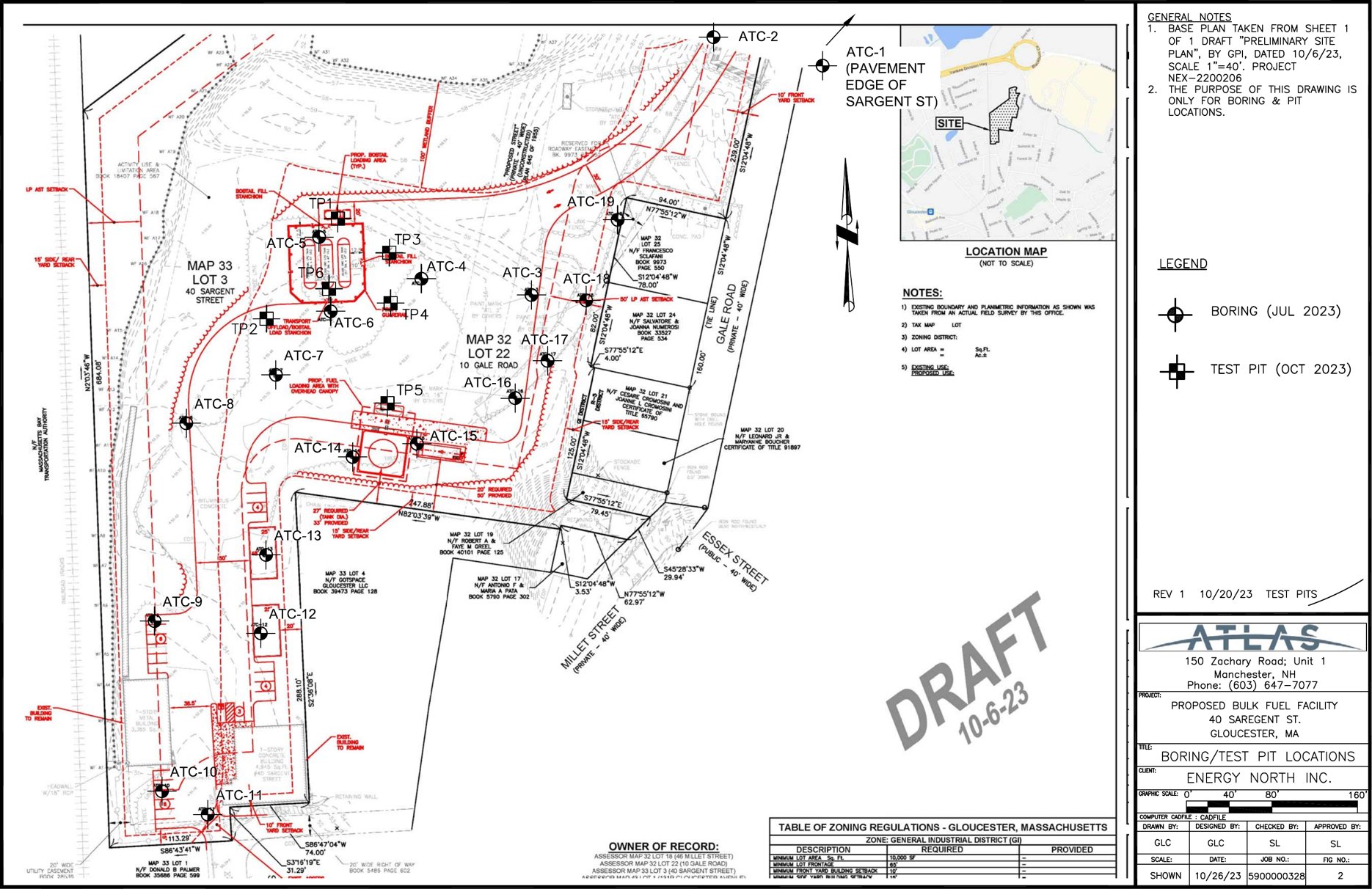
The 2023 concept is visible in the application as a drawing. The Atlas boring and test pit plan below is drawn over a layout whose title block reads "Proposed Bulk Fuel Facility" and whose labels include a fuel loading area with an overhead canopy, bobtail truck loading areas and propane setback lines. The application's current plans do not show these.
The fuel storage question
"I can tell you definitively and commit on the record that we're not going to build a bulk fuel plant there. That plan is, it was an old plan, it's off the table, that's not going to happen."Attorney for Energy North, Planning Board hearing, Oct. 1, 2026
190,000 gallons
of tanks described in a 2023 geotechnical report for Energy North: 80,000 gallons of heating oil, 20,000 of diesel and three 30,000 gallon propane tanks. The report is Attachment B of the application filed Aug. 13, 2026.
Nothing is in writing from the company on what it will do instead.
Fuel storage is not proposed. The filing proposes no use, and no tanks appear on any plan. On Oct. 1 the applicant's attorney said: "I can tell you definitively and commit on the record that we're not going to build a bulk fuel plant there. That plan is, it was an old plan, it's off the table, that's not going to happen." The draft minutes record it as Energy North not planning to develop a bulk fuel plant on the site.
Three things keep the question open. The only document describing a use is the 2023 fuel layout, and it is still in the application. Nothing is in writing from Energy North, and no condition limiting use has been proposed. The attorney also said any future building would need site plan review, but a board member pointed out that once the road is approved, a depot could return later with no way to undo the road. Gloucester's use table lists "Bulk storage, warehousing" and "Fuel or ice establishment" as allowed by right in General Industrial, with no row for a bulk fuel terminal by name, and a City Council special permit for storing hazardous materials incidental to industrial operations. If the site is inside the Watershed Protection Overlay, petroleum storage would be prohibited. We have not matched the site to that overlay map. Part 5 has the table and the caveats.
The rescheduled hearing notice sent to Ward 2 residents and abutters lists the 190,000 gallons of tanks from the geotechnical report and says the scale of what is described goes well beyond a typical General Industrial build out. That is the notice's own characterization, not a finding by the board.
The Oct. 1 hearing
The hearing was first set for Sept. 17, but a noticing error meant it could not be held, and it moved to Oct. 1. That made Oct. 1 the first public hearing on the definitive plan. The April hearing was on the preliminary plan.
The planning director and the Health Department recommended independent peer review across disciplines: subdivision standards, wetlands, stormwater, traffic, environmental, utilities and drainage. The director said the existing stub road was never reviewed as a subdivision road and nobody knows what is under it. He called a nine truck a day scenario a lighter use than a site this size could carry and said the review should test more intense uses. The applicant pays for peer review, and the city picks the reviewer. The city will not test the soil itself, because the site is under the state cleanup program. The board voted unanimously to authorize the review and continued the hearing to Nov. 5. The applicant still owes a consolidated waiver list, street trees on both sides or a waiver, a final version of the soils opinion, cores of the existing stub road, a response on more intense traffic scenarios, and a map of the restricted and release areas against the road and basin.
Both city memos are dated Sept. 10. The planning director's memo notes that the site is bounded on the west by the MBTA commuter rail, sits close to homes, and would be reached through the roadway system serving the Halyard Apartments, the bank, the YMCA and Gloucester Crossing. It asks the reviewer to judge whether the submission shows compliance on subdivision, engineering, stormwater, traffic, environmental and public safety points, and to name any added data, testing or certifications the applicant should provide.
The Health Department letter reports that the applicant's consultant concluded the infiltration basin is unlikely to materially affect groundwater quality, based on earlier groundwater testing, and that the work is consistent with the restriction if its requirements are followed. The department still questions putting infiltration into fill that contains trash, car parts and concrete. It also says the consultant assumed less than 20 cubic yards of disturbance in the restricted area because the preliminary plans lacked enough grading and subbase detail to say. It asked that the applicant pay for a city commissioned third party review, and that the applicant confirm the licensed site professional, soil management plan and health and safety plan will be in place before any work there.
What residents asked for
Seventeen people spoke on Oct. 1 and none supported the plan. Of 17 written comments on file as of Oct. 15, 15 oppose it, one poses questions and one sets conditions for redevelopment. A neighbor says that letter was withdrawn and that the neighborhood does not support the project. Eleven name the fuel tanks. Part 4 sorts the concerns in full.
What the Conservation Commission filing says
Sargent Street Corp. filed Notice of Intent 028-3159 for a road, a stormwater system and utilities inside the 100 foot buffer of a wetland. No buildings are proposed. On Oct. 7 the Commission voted 4 to 0 for an outside peer review, asking for proof that infiltration works in contaminated soil, testing of all soil under the road and an independent monitor for excavation. The case was continued without a hearing on Oct. 21 and Nov. 4, to Nov. 18. Part 3 covers the ground, the wetland and the review.
Background: Energy North and what a fuel use would involve
The application proposes no fuel storage, and the applicant's attorney said on Oct. 1 that a bulk fuel plant is off the table. The rest of this article is background for readers who asked what a fuel use would involve. It is here because the applicant is a fuel company, a 2023 concept showed 190,000 gallons of tanks, and residents raised the question at the hearing. None of it describes a proposal before either board.
Energy North in other communities
Energy North Group is based in Lawrence and sells heating oil, propane and gasoline, and runs Haffner's convenience stores, across Massachusetts, New Hampshire and Maine (trade report). Because the name "Haffner" is on the flyer for this project, we looked at what public documents show about the company in other towns.
We picked these places because they are the ones where a public filing or decision we could open names the company. It is not a full list, and we did not find complaint counts or neighbor petitions for any town.
| Place | What the public record shows | Source |
|---|---|---|
| Groton, MA | State environmental officials issued Energy North, Inc. a $22,000 penalty notice after a 2019 fuel oil delivery to a home. A fuel tank had a ruptured outer wall and a spill of about 3 to 5 gallons in the basement. The company did not tell the state within two hours, as the rules require. The state issued a final decision on April 30, 2025 and a further final decision on reconsideration on Sept 30, 2025. We have not confirmed the penalty amount that stood. | MassDEP recommended decision, June 7, 2024; final decision, April 30, 2025 |
| Littleton and Ayer, MA | Energy North Group asked the Littleton Planning Board for a site plan and special permit for a new fuel station with a 6,000 square foot store, 10 retail fueling positions and 2 commercial diesel positions, inside a Water Resource District. The letter does not give tank sizes or truck counts. | Cover letter, Feb 8, 2023 |
| Gloucester, MA | Energy North reopened a Haffner's gas station and store at 71 Essex Street, set for Dec 19, 2023. | Company announcement |
| Several towns | The company bought convenience and fuel sites in Ashland, Manchester, New Hampton and Plymouth, N.H., Groton and Winthrop, Mass., oil dealers in Ayer, Mass. and Elliot, Maine, and a car wash in Littleton. | Trade report |
Milford, N.H. In 2010, the U.S. EPA announced a $49,000 settlement with Draper Energy, the owner of a Mobil station, and Energy North Inc., which operated it. A pipe break on March 5, 2009 let about 1,500 gallons of diesel leak, and the alarm failed. The diesel reached the Souhegan River. EPA alleged the companies had no required spill prevention plan and illegally discharged oil (EPA news release, July 29, 2010).
The Milford spill also drew a second, state level settlement. New Hampshire's Attorney General settled with both companies for a combined $60,000 civil penalty under the state's Oil Discharge and Spillage Act. The companies also agreed to give up any claim on the state's Oil Discharge and Disposal Fund for up to $95,000 of cleanup costs (Legal Newsline report). A penalty database lists the same $60,000 with a date of June 8, 2010 (Violation Tracker). We did not find the state's own order. The news page shows a much later posting date than the settlement, so confirm the terms with the New Hampshire Attorney General's Office. The EPA and state amounts are separate settlements by separate agencies, and the split between the two companies is not stated.
Trucks. Federal records for Energy North Inc. (USDOT number 2576062) show 115 power units and 68 drivers as of Nov 4, 2026. Over the prior 24 months there were 12 hazmat inspections with none out of service, against a national out of service rate of 4.44 percent, and 2 reported crashes (1 injury, 1 tow away, none fatal). Crash reports do not decide fault. The carrier's safety rating is Satisfactory, assigned March 19, 2018 (FMCSA carrier snapshot). These are company wide figures, not Gloucester figures.
What this does and does not tell us. The Groton penalty involved a home heating tank, and the Milford spill involved a service station tank. Neither was a large storage site. It shows how the state treated one company's reporting duty. It says nothing about the Sargent Street site. The Littleton filing shows the kind of project the company has brought to a planning board before, but no such filing has been located for Gloucester.
Still missing: a list of every state release report tied to the company, any inspection records, and local meeting minutes from Littleton and Ayer. Those would need public records requests.
Why Energy North may want to expand here
No record we found says why the company wants the Haffner's Way land or what it would build there. What we can report is how the company describes its own growth, and what it has done in Gloucester so far.
A company that grows by buying. Energy North's history page lists a purchase nearly every year since 2009, including Webber Oil, Haffner's Oil, Ayer Oil and Hanscom Oil, and 11 locations from VERC Enterprises in 2021 (company history). In 2021 its leader said he was "thrilled to expand our gas station, convenience store, car wash and foodservice footprint," and the company described four new ground up projects in Maine and Massachusetts (Butane/Propane News, April 1, 2021). In June 2023, Haffner's bought Huhtala Oil & Propane and Concord Oil, which includes several bulk fuel storage sites in Acton and Concord. Its CEO said the aim was to "expand our energy resources and offer customers a wider range of options." At that time Haffner's reported 71 locations and close to 45,000 customers (Convenience Store News, June 21, 2023). An industry ranking lists it at 78 stores on Jan 1, 2026, ranked 93rd, up from 103rd (CSP Daily News).
What it has said about Gloucester. The company reopened its station at 71 Essex Street on Dec 19, 2023, after what it called several years of redevelopment. Its chief retail officer said the reopening "aligns with our strategic vision for growth and community connection" (Butane/Propane News, Dec 18, 2023). That was a store, not a storage site.
What we cannot tell. The subdivision would create building lots and a road. Nothing public says whether the lots are for fuel storage, truck parking, offices or resale. The company has not published a reason. These questions are fair to ask in public:
- Is the plan to serve Cape Ann customers from a site in Gloucester?
- Will the lots hold fuel storage, trucks, or something else?
- Will Energy North own the lots after the sale, or sell them on?
Violations and enforcement, side by side
This table lists every enforcement matter we could open from a government source. Some involve companies Energy North bought later. Read the last column before comparing them.
| Date | Place | Company named | Agency and issue | Status | Link to Energy North |
|---|---|---|---|---|---|
| Sept 30, 2025 | Groton, MA | Energy North, Inc. | MassDEP. $22,000 penalty notice over an unreported threat of a heating oil release at a home. | Final decision on reconsideration issued. Penalty that stood not confirmed. (decision) | Direct |
| July 29, 2010 | Milford, NH | Energy North Inc. (operator) and Draper Energy (owner) | EPA. About 1,500 gallons of diesel reached the Souhegan River. No required spill plan alleged. $49,000 combined settlement. | Settled. (EPA) | Direct, as operator |
| June 8, 2010 | Milford, NH | Energy North, Inc. (operator) and Draper Energy Company (owner) | New Hampshire Attorney General. Same diesel spill, charged under the state Oil Discharge and Spillage Act. $60,000 combined civil penalty, plus giving up any claim on a state cleanup fund for up to $95,000 of cleanup costs. | Settled, per a news report and a penalty database. State's own order not found. | Direct, as operator |
| Mar 12, 2020 | Harvard, MA | Concord Oil Co. | MassDEP. Petroleum found in a private drinking water well near the company's Depot Road bulk storage site. Failed to report promptly and to act on possible exposure. $20,240 penalty. | Assessed. (MassDEP) | Before the 2023 purchase of Concord Oil |
| Oct 5, 2000 | Harvard, Concord, Acton and Westford, MA | Concord Oil Co. | EPA. Alleged no spill prevention plans at four of five facilities. $137,500 proposed penalty. | Proposed. Final outcome not found. (EPA) | Before the 2023 purchase of Concord Oil |
How to read it. Three items are about Energy North itself (the Groton matter and two settlements over the one Milford spill), and all involve failing to prevent or report a fuel release, not a large storage site. The Concord Oil items belong to a company that Energy North's parent group reportedly bought in 2023, so they are history, not Energy North's own violations. They matter because that purchase brought bulk storage into the group. One caution: Energy North's own history page lists a Concord Oil purchase in 2014, while 2023 trade reports describe the Acton company as a recent buy. These may be two companies, and we have not settled it.
The EPA's 2000 release also explains why such plans matter. It said missing plans "increased the possibility that large amounts of oil would reach" nearby waters, and all four sites were near rivers or streams.
We have not reviewed consumer complaints or lawsuits. If we do, they will be described as claims, not findings.
Fuel on the road: the transportation record and risk
A fuel site is also a trucking operation. A spill from a tank is one risk. A crash that spills a truckload on a public road is another, and the two can combine when fuel reaches a storm drain.
The company's federal record. The federal carrier snapshot for Energy North Inc. (Nov 4, 2026) shows 115 power units and 68 drivers. In the prior 24 months, it shows 12 hazmat inspections, 15 vehicle inspections and 20 driver inspections, with none out of service. The national out of service rates it lists are 4.44 percent for hazmat, 22.26 percent for vehicles and 6.67 percent for drivers. There were 2 reported crashes (1 injury, 1 tow away, none fatal). The safety rating is Satisfactory, from March 19, 2018 (FMCSA snapshot). By these numbers, the roadside inspection results are better than the national averages. Crash reports do not decide fault, and the figures cover the whole fleet, not Gloucester.
What the research says about tanker rollovers. A federal fact sheet reports more than 1,300 cargo tank rollovers a year in the U.S., about 4 a day. It says driver error is involved in about 78 percent. Most were not on sharp curves or wet roads: 56 percent happened on straight roads and 93 percent on dry roads. Partly full tanks were in 63 percent of rollover crashes (FMCSA cargo tank rollover fact sheet, based on a 2007 study). A 2017 study for the federal pipeline and hazmat agency found driver performance errors were the most common factor and found gaps in tanker driver training (Volpe Center study). These are older national findings. They do not say that Energy North trucks are likely to crash.
Why it matters on Cape Ann. The Revere and Athol cases in the spills section below began as tanker rollovers and became waterway spills through storm drains. Neither case involved Energy North. Gloucester's own risk depends on facts we do not have: how many tanker trips, which routes, what hours, and how close those routes run to wetlands and drains.
Questions for the Planning Board:
- How many tanker and delivery trips a day are expected, and on which streets?
- Will any route cross or run beside wetlands or storm drains?
- Which carrier would make the deliveries, and what is its record?
- How would the Fire Department respond to a rollover at the site entrance?
General risks of fuel storage and delivery
No one has filed a use for the Sargent Street lots, so nothing below is a finding about this site. These are public figures on the kinds of places a fuel company often runs: tank sites, gas stations and truck depots. They show what the risks are and how large they have been elsewhere.
Leaking underground tanks. The U.S. Environmental Protection Agency says it and its partners have cleaned up more than 500,000 petroleum releases from underground tank systems. More than 60,000 remained in a backlog, and thousands of new ones are reported each year. EPA names groundwater as the biggest threat, since groundwater supplies drinking water for nearly half of the country. Leaks can also cause fires, explosions and fumes that seep into buildings (EPA news release, Nov 30, 2021).
Oversight gaps, as of 2002. In testimony to Congress, the Government Accountability Office counted 416,702 known tank releases nationwide at the end of 2001. About 9 percent had no cleanup under way. Only 19 states inspected all their tanks at least every three years, and 22 states had no regular schedule (GAO-02-753T, May 21, 2002). This is old data, and rules have tightened since. It is included to show why inspections matter, not to describe today's rate.
Benzene near gas stations. Benzene is a chemical in gasoline linked to cancer. Health Canada found that fumes from gas stations may pose unacceptable risks to people living nearby. It estimated 3 to 32 extra cancer cases per million people at 20 meters from a station fence over a lifetime, and said station emissions reach out to roughly 70 to 300 meters. It also found short bursts of benzene while tanker trucks unload, above a California short-term health level out to about 210 to 240 meters (Health Canada report, page dated March 10, 2023). These are Canadian findings about retail stations, not a Massachusetts rule and not about this site.
Fire and traffic. Massachusetts sets fire safety rules for storing and dispensing flammable liquids in its state fire code, 527 CMR (code listing). We did not review the sections that would apply. We also found no public truck count for any project on Sargent Street.
Why contaminated ground matters. EPA names groundwater and fumes as the main paths by which tank leaks reach people, and Health Canada focuses on fumes. That is why the Commission's questions about draining stormwater into restricted soil are the right ones to follow.
Spills elsewhere in Massachusetts
These four state and federal cases show how fuel moved through storm drains and pipes into waterways. They involve other companies and sites. None names Energy North, and none predicts what would happen in Gloucester. The list is a selection, not a complete statewide count.
| Date | Place | What happened | Reported amount | Outcome |
|---|---|---|---|---|
| Dec 22, 2021 | Athol | Tank truck rollover | About 4,500 gallons of fuel oil | Reached Mill Brook and the Millers River. EPA announced a $35,354 penalty against the trucking company on Oct 19, 2022, covering this spill and the Revere spills. |
| Oct 13, 2021 | Revere, Brown Circle Rotary | Tanker rollover | Estimated 10,000 gallons of heating oil | Went through a storm drain to Rumney Marsh, Diamond Creek and the Pines River. $116,458.50 state settlement in 2023. |
| Apr 17, 2020 | Revere, Brown Circle Rotary | Tanker rollover | 10,000 gallons of gasoline and 1,000 of diesel | Went through a storm drain to Rumney Marsh and on to the Pines River and the Atlantic Ocean. $52,746 settlement in 2021. |
| Mar 2006 | Chelsea Creek | Pipeline between storage tanks and a fuel dock | About 18,000 gallons of heating oil | Reached Chelsea Creek and Mill Creek. $312,500 settlement in 2008. |
Settlement amounts and spill sizes are as the agencies reported them. The Revere 2021 volume is a state estimate, and EPA gave a separate, lower estimate of 3,000 to 5,000 gallons in an account we did not open. Sources: MassDEP oil spill settlements and EPA, Athol and Revere settlement.
Rules and plans that would apply
No use is filed for the lots, so no one can say yet which of these apply. This table shows what the rules require if fuel is stored or loaded on the site. We read summaries and the text of the state fire code. The Gloucester zoning text came from an unofficial online copy, so confirm it with the city.
| Rule | When it applies | What it requires |
|---|---|---|
| Wetlands Protection Act, Notice of Intent | Work in or within 100 feet of a wetland. This is the filing now before the Conservation Commission. | A hearing, a peer review if the Commission votes for one, and an order of conditions. (minutes) |
| Massachusetts Contingency Plan | Any oil release or threat of one. | Prompt reporting to MassDEP, including a 2 hour deadline for some threats, and a licensed cleanup professional. The Groton penalty was about missing this deadline. (MassDEP decision) |
| Federal spill plan (SPCC, 40 CFR 112) | More than 1,320 gallons stored aboveground in total, or more than 42,000 gallons buried, with a reasonable chance of a spill reaching waters. | A written plan with containment that holds a tank's full capacity plus rain, procedures for tank truck loading and unloading, inspections, training, and an engineer's certification unless the site is small with a clean record. The plan stays on site and goes to EPA only on request. (EPA guide) |
| State fire code, 527 CMR 9.00 | Fuel tanks above or below ground. | A State Fire Marshal permit for aboveground tanks over 10,000 gallons. The fire chief decides on diking for aboveground tanks and must be notified before underground tanks go in. Underground tanks need double walls, overfill protection and leak detection. (527 CMR 9.00) |
| Emergency planning forms (EPCRA) | Sites above chemical storage limits. | Chemical inventory forms filed with state and local emergency planners. In 2007, EPA alleged that Draper Energy had not filed them for its Wilton and Milford, N.H. sites. (2007 EPA action) |
| Federal hazmat trucking rules, 49 CFR | Hauling gasoline or diesel in cargo tanks. | Annual hazmat registration for tanks of 3,500 gallons or more, driver training every three years, placards, shipping papers, and an emergency phone number. A security plan applies to large loads of gasoline, which is usually Packing Group II. Diesel generally is not. (FMCSA) |
| Gloucester zoning | Land use in the General Industrial district. | The ordinance defines outdoor bulk storage to include bulk storage of liquids in tanks, and defines transportation terminals and truck parks. Gas stations in the district go to the Zoning Board under Section 5.21. Special permit reviewers must weigh traffic flow and safety and the natural environment. We did not read the district's use table, so we cannot say which permit bulk fuel storage would need. (ordinance, unofficial copy) |
Will there be a transportation plan?
A traffic study was filed, but it models a hypothetical two building industrial site of 35,450 square feet, with 128 weekday trips and 9 trucks. We found no truck routing or fuel delivery plan, because no use is proposed. A road plan is not a truck plan.
The city's subdivision rules require a Traffic Impact Report only for subdivisions of 20 or more lots. This filing is for two lots, so the rule does not apply. The board's April 16, 2026 conditions for the preliminary plan still required a traffic impact and access study for the definitive plan, and the applicant filed one (see the subdivision section near the top).
The federal spill plan must cover how tank trucks load and unload on site, but it is kept at the facility and does not map routes through neighborhoods. The federal trucking rules govern drivers, trucks and paperwork, not which streets a carrier uses. Nothing we read requires a route plan for local streets. The city can still ask for one. Its special permit factors include traffic flow and safety, and the Planning Board reviews road layouts.
That makes the question a public one: how many tankers a day, on which streets, at what hours, and who will answer if one rolls over.
Is there a risk to neighbors?
It depends on what is built, and that is not filed. We have not mapped nearby homes, private wells or public water supplies, so we cannot say how close anyone lives to the lots.
The documented pathways, from the sources above, are these:
- Groundwater. Leaks from tanks can reach drinking water. This site already has contaminated soil under a land use restriction.
- Fumes. Benzene from fuel can reach nearby homes, with short spikes during truck unloading.
- Fire and explosion. EPA lists these as risks of tank leaks.
- Trucks. Rollovers can spill fuel onto roads and into storm drains.
- Stormwater. The filed plan sends rain into the ground over restricted soil, which is why the Commission asked for a peer review.
The rules above exist to limit these risks. Whether they are enough depends on the design, which no one has seen. The most useful public step is to ask for a map of homes and wells within a set distance, and a list of what would be stored.
Meetings and how to comment
The Conservation Commission meets Wed., Nov. 18 at 5:30 p.m. at the Rose Baker Center for Aging Well; its posted agenda lists the Haffner's Way filing with the applicant's request to continue it to Dec. 2. The Planning Board meets Thu., Nov. 19 at 5 p.m., the date its Nov. 5 agenda set. The city posts agendas 48 hours ahead and the Nov. 19 agenda will give the place. Check the city calendar before you go. Send Commission comments to [email protected] with 028-3159 in the subject line. Part 7 has the questions worth asking.
Glossary
| Term | Plain meaning |
|---|---|
| Notice of Intent (NOI) | The application to a local Conservation Commission for work near wetlands. |
| Buffer zone | The land within 100 feet of a wetland, where work needs approval. |
| Peer review | An outside engineer hired to check the applicant's plans. |
| AUL (Activity and Use Limitation) | A deed restriction that limits what can be done on cleaned-up land. |
| RTN (Release Tracking Number) | The state's ID number for a reported spill or release. |
| MCP (Massachusetts Contingency Plan) | The state rules for reporting and cleaning up oil and chemical releases. |
| Variance | Permission from the Zoning Board to break a zoning rule, such as frontage. |
| Frontage | The length of a lot that touches a public road. |
Sources
All pages below were opened and read for this draft. Figures are as of Nov 6, 2026.
- City of Gloucester Planning Board file: Final Haffner's Way Subdivision Application, Aug. 13, 2026 (313 pages, Attachments A to H, including the Atlas geotechnical report, traffic study and stormwater report)
- City of Gloucester Planning Board file: Haffner's Way public hearing notice
- City of Gloucester Planning Board shared Drive folder, Haffner's Way (application, staff comments, public comments)
- Gloucester Conservation Commission minutes, Oct 7, 2026
- Gloucester Zoning Board of Appeals minutes, Feb 27, 2025
- MassDEP Recommended Final Decision, Energy North, Inc., June 7, 2024
- MassDEP Final Decision, Energy North, Inc., April 30, 2025
- Raveis listing, 40 Sargent Street
- Littleton Planning Board submittal cover letter, Feb 8, 2023
- Convenience Store News on Energy North Group acquisitions
- Haffner's announcement, Gloucester station
- EPA news release on underground tank cleanups, Nov 30, 2021
- GAO-02-753T, MTBE Contamination From Underground Storage Tanks, May 21, 2002
- Health Canada, benzene releases from gasoline stations
- Massachusetts 527 CMR listing
-
Cape Ann Climate Coalition Facebook post (meeting dates, not yet matched to a city agenda)
- EPA news release on the Milford, N.H. settlement, July 29, 2010
- FMCSA carrier snapshot, USDOT 2576062, Nov 4, 2026
-
MassDEP Final Decision on Reconsideration, Energy North, Inc., Sept 30, 2025
- MassDEP natural resource damages oil spill settlements
-
EPA news release on the Athol and Revere tanker spill settlement, Oct 2022
- Butane/Propane News on Energy North expansion, April 1, 2021
- Convenience Store News on Huhtala and Concord Oil, June 21, 2023
- Butane/Propane News on the Gloucester reopening, Dec 18, 2023
- CSP Daily News ranking of Energy North Group, 2026
- MassDEP penalty on Concord Oil, Harvard, March 12, 2020
- EPA complaint against Concord Oil, Oct 5, 2000
- FMCSA cargo tank rollover fact sheet
-
Legal Newsline on the New Hampshire Attorney General settlement
-
Violation Tracker entry, Draper Energy Company and Energy North, Inc.
- 527 CMR 9.00, tanks and containers, Massachusetts fire code
- FMCSA, how to comply with hazardous materials regulations
- Bulk Transporter on EPA's 2007 action against Draper Energy
- Gloucester Conservation Commission agenda page, Nov 4, 2026
- Gloucester subdivision rules and regulations, 2008
How we worked on this. We read the city's posted minutes and state decisions. We did not attend or watch the meetings online. By Cape Ann Current Staff.
Sources
Do you trust this story?
See something wrong? Email [email protected]. Read our standards and corrections policy.